

It doesn't get more textbook than this:
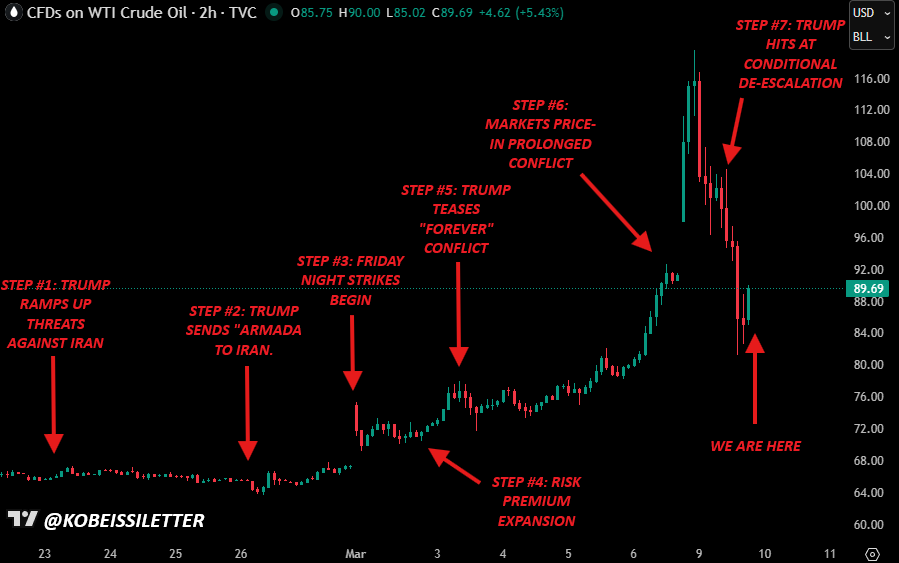
Every step of our March 3rd "Conflict Playbook" has been outlined on this oil price chart.
It began with Steps #1 and #2 when Trump sent an "armada" to Iran and ramped up threats.
On February 27th, we saw the "Friday night strikes" from Step #3 of our playbook.
This led to Step #4 as risk premiums were rapidly priced-in.
On March 3rd, President Trump began saying the war could last "forever," as expected in Step #5.
Then, on Friday and last night, markets began pricing in Step #6, a prolonged conflict sending oil prices to $120/barrel.
Finally, today at 3:20 PM ET, President Trump hinted at "conditional de-escalation" from Step #7 of our Conflict Playbook.
We are now nearing Step #8. Keep following along.

AI时代下,将何去何从?
每个人都很焦虑,因为AI发展的太快了,效率指数级提高,很多工作和公司可能会被颠覆掉。而这里有一个最核心的问题是,AI的最终形态是什么?
这个问题之所以重要,历史的经验告诉我们,在一项革命发展中,中间的形态将全部成为炮灰。实际上,过去2年,连AI的新技术都已经被淘汰了。如果是个人,很容易形成每天要拼命的学新技能的苦逼模式中。
而这个问题,我也一直思考了很久。最近有一个答案开始越来越清晰。那就是,个性化的私人AI。
1 AI加持下的完全个性化
每个人都是一个独立的个体,有着不一样的喜好。吃饭,有人喜欢辣,有人喜欢清淡,菜有火锅、烧烤、麻辣烫等等。出去旅游,有人喜欢爬山涉水、有人喜欢轻松悠闲。
商业的核心价值是在解决问题。而现在商业的模式基本是,大公司会解决大部分人普适的需求,中线公司的会解决小部分人的集中需求。而未来,会由AI来解决每个人不同的需求。
从社会实际发展的维度来看,工业革命的生产力提高,从统一的商品到各类不同的风格。从大家都看一样信息的门户网站,到抖音这种个性化推荐。都是在满足更高个性化的演变。
而在未来,在AI的加持下,可以实现完全个性化的需求。满足每个人独立个体的与众不同的偏好
2 人类与AI的关系
现在还有一种担心的观点,AI现在能力这么强,以后不需要人干什么了。这也是极其悲观的想法。事实是每一次的科技进步,都会改变很多。就像互联网出现后,报纸杂志开始消失了,但是出现了自媒体博主,带货主播。
最核心的是,主要有人在,就有需求。而人的欲望是永远不会被满足了,有了好东西后,如果出现更好,更更好的,那就也想要。
至于AI会产生自我意识,担心电影里的桥段那样AI统治世界,我觉得是杞人忧天了。而且AI是人类发明,即使AI足够强大,为何不是成为好朋友呢?
3 中间形态很多公司会大量死去
现在的很多产品,是中间形态,必然会淘汰的。举个列子,比如说vibe coding的IDE模式,fork了vs code的界面,那界面是给程序员用的。
对于普通人,根本不应该看那么多功能的界面。只需要把自己想要的描述清楚,ai 自己coding实现想要的功能就行了。
现在的社会存在大量的中间形态的产品,这是因为AI的替代会有一个时间的过程。现在大部分公司只是简单的采用,产品中加入AI的方式,或者让员工使用AI来提升效率。但是,他们还没想明白,他们只是中间形态而已。
同时对于创业者,应该时刻提醒自己,不要带有现有世界的固定模型/知识,跳出固有的思维模式,否则很容易作出中间形态的产品。而是多思考未来AI的能力,未来AI构建的新的社会形态
4 未来的形态
未来AI+人类的世界中。
1)一个重要的形态,一定是AI带来的个性化。Openclaw能够这么火,就是符合这样的一个底层逻辑。
2)大模型和相关基建,这个不多说,大家一眼都清楚
3)专业的服务+面向AI的交互方式,这也是在未来大量存在。1是虽然AI能力非常强,但是并不能代替所有,特定领域的知识,经验,专业技能,独有的数据。在未来反而更加是稀缺的 。但是未来最好的形态,是需要将这些能够面向AI交互。也就是说,这些专业的服务的形势,并不是现在的样子,而是能够让AI访问,使用的。
好吧,就写这么多吧。
有新的思考,再跟大家交流。

我知道有相当数量的人和我一样,不舍得卖币,就说 BNB 从高点 1300 跌到 650 打了个对折,我也一枚没卖
一方面是在琐碎的叙事中忽略了周期,等幡然醒悟已经几乎磨平了收益,再卖就没有必要
另一方面是认为 BNB 是能穿越周期的少数价值标的
尽管未来 BNB 能涨到 2000 甚至没准更高,但这中间的时间怎么办,就只能放在交易所吃灰,靠 0.16% APY 度日吗
看起来并非如此,我在前几天一场 AMA 里找到了答案,最近通过自己体验尝试产生了以下思考
BNB 生态相较于其他公链的优势在于,拥有很多原生的 DeFi 协议,可以在波动中穿越牛熊获得收益
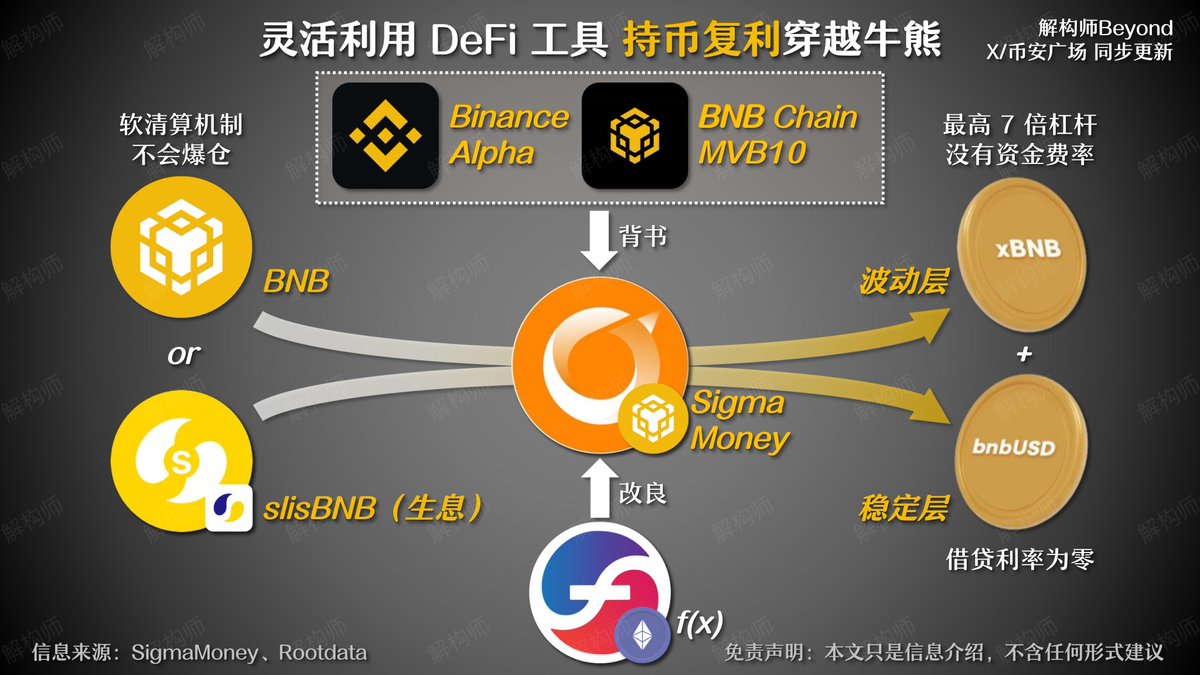
如同 f(x) 之于 ETH,Sigma 就是 BNBChain 生息的一个解
Sigma(@sigmadotmoney) 的原理是将 BNBChain 原生资产比如 BNB 或 slisBNB 拆分成两部分:
- 稳定层 bnbUSD 提供下行保护的稳定币,支持 0% 借贷利率铸造
- 波动层 xPOSITION / sPOSITION 提供杠杆风险敞口,支持最高 7 倍做多或做空
这样操作的优势也很直观,列举几个场景:
- 持有 BNB 的用户可以在不卖出资产的情况下,就获得美元流动性 bnbUSD,而且借贷利率为 0
- 可以开立最高 7 倍的杠杆头寸,却不用支付资金费率,适合长线持仓
- 可以套娃滚雪球获得收益,本身的 slisBNB 是一层,还可以通过存入 slisBNB 获得 bnbUSD 存入稳定池再获得一层收益
此外 Sigma 还有一个软清算机制,个人认为也做得不错
当抵 LTV 到达 88% 会自动卖出一部分抵押品来降低杠杆率,而不是直接爆仓,增大了投资组合的弹性
此外币安亲儿子稳定币 U 和 Sigma 一起在 Curve 上开放了一个 U-bnbUSD 池子,多提供了一种稳定币理财的途径
写这些的目的并不在于无脑鼓吹 Sigma 或者其他 BNBChain 的协议有多好,能提供多少收益
而在于反思如何在币本位视角下度过熊市穿越周期,利用各种 DeFi 工具来实现超额收益
囤更多币,在下轮周期赚更钱,才是我们的核心诉求
(本文并非推广,没有邀请链接,不含任何建议,仅为个人思考,须知一切 DeFi 工具都存在不可避免的系统性风险)

比特币唯一正式合并进官方代码库的抗量子提案BIP360是做什么的?量子计算和宇宙采矿分别是悬在比特币和黄金头上的两把剑,但目前来看好像量子计算被攻破的可能性更大,虽然我们币圈自己人对于量子计算好像一直抱有无所谓的心态,但是传统金融对于量子计算的恐惧性还是非常大的,这也阻碍了不少人放心的把钱投进来,毕竟一旦被攻破就灰飞烟灭了。
那目前比特币的抗量子计算进展到了什么阶段?
就在上个月,BIP 360倍正式合并进了比特币官方的代码库,目前处于社区审查和迭代状态,这也是目前唯一一个和量子计算有关系的BIP,所以可以说它是比特币对抗量子计算现阶段的独苗,链接如下https://t.co/tfOX6cQSLN
量子计算对比特币的威胁在于它可以通过公钥反推出私钥,从而转移走钱包里的资产。而比特币的公钥又因为交易验证机制,导致只要你花了钱就被迫要暴露在链上。
所以对抗量子计算听起来最简单的方式就是,有没有可能我不把公钥暴露在链上?
BIP 360实现的就是这个效果,在此之前Taproot为了让交易实现过程更加简单高效,其输出内容包含了这笔交易的公钥,BIP 360的输出内容则去除了公钥,而将其隐藏进了Merkle root脚本里,从而不会在交易过程中直接在链上长期暴露公钥,但坏处则是Gas费更贵一些,单笔转账多出来大概30%,不过为了安全这个数字完全可以接受,况且本身比特币频繁转账的场景就不多。
另外不少人有个误解,认为BIP 360的输出不包含公钥后,就会增强比特币的隐私性,因为会下意识认为“地址被隐藏看不出来了”,其实不是,公钥和地址是两个不同的东西,地址是由公钥再结合其他的信息生成的,所以公钥隐藏后并不影响交易地址本身的存在。
但BIP 360没办法向前兼容,即指针对于新钱包有效,之前已经存在的钱包不会自动获得保护,用户必须要手动迁移资金到新的地址。
但是因为很多钱包的私钥都已经丢失了,这些钱包里的比特币自然也没办法手动迁移获得保护,尤其是中本聪的钱包,所以即使BIP 360升级成功,占据比特币总量超过15%的大量死钱包依然不安全面临量子攻击。
而除了BIP 360其他的解决方案也都没办法向前兼容,目前业界没有任何其他好办法能够对这些死钱包进行无需人工干预的保护,除非是直接进行硬分叉将这些钱包强行冻结再迁移,但会导致比特币的社区分裂甚至崩塌。
所以现在量子计算的威胁对于比特币来说,并不是致命性的打击,毕竟活钱包都是完全可以抵御的,但最大的问题就是这些死钱包存在被“复活”的可能。

The Ethereum Foundation is using DVT-lite to stake 72,000 ETH:
https://t.co/V5x9TrdXoU
My hope for this project is that in the process, we can make it maximally easy and one-click to do distributed staking for institutions. Choose which computers run your nodes, make a config file where they all have the same key, and then from there everything gets set up automatically.
The idea that "running infrastructure" is this scary complicated thing where each person participating must be a "professional" is awful and anti-decentralization, and we must attack it directly.
It should be a docker container or nix image or similar, one click or command line per node, enter the same key in each node, and they automatically find each other, the networking is set up, the DKG happens, and the staking begins.
I also plan to use this soon, and I hope more institutions holding ETH can stake in this way. We want the authority over staking nodes to be highly distributed, and the first step to doing this is to make it easy.

Davide Crapis是以太坊基金会AI负责人,他提到了ERC-8183(以太坊的新标准)。
这个标准是怎么来的,是跟@virtuals_io 团队合作推出的,Virtuals团队有ACP协议(我们之前也提到过很多次),现在跟以太坊合作,进行了简化,最终变成了ERC-8183。Virtuals承诺让它中立,这样大家都可以用。
那么,ERC-8183到底是什么?
当未来AI agents市场经济发展起来的时候,AI agent之间会相互“雇佣”对方帮自己做事(比如帮忙分析数据或执行任务)。
不过,AI之间如何才能相信对方,如果不能相信对方,怎么确保把活干好了才付钱?这不单纯是支付的问题。
Davide之前觉得需要“托管支付”(escrow)来解决,就是将钱先放在第三方那里,活干好再放款。
在这样的背景下,ERC-8183出来了。
它的核心是,条件支付。只有满足特定条件(比如工作完成、验证通过等),才会把钱转过去。
它是一个“托管支付”的机制,专注于AI agent之间条件支付。ERC-8183可以和x402(小额支付)、
8004(寻找可靠AI代理)组合。
ERC-8183可扩展、可模块化,能加各种hooks来适应不同工作类型,满足多场景需求。因为它满足的不仅是支付(x402可以满足)需求,也涉及到经济交易(协议、验证、退款等),ERC-8183可以满足更多AI代理市场经济的需求。
有ERC-8183的好处是,让AI Agent之间的经济往来更安全、更高效,防止骗子,对繁荣AI agent经济体有帮助。
最后,以太坊基金会的dAI团队会帮忙推广,让更多人用它来构建。

在老家过了一个长长的春节,不看行情的日子确实轻松,一回来发现外面都是龙虾🦞,AI的发展速度和焦虑恐怖如斯,不忘初心回到加密行业,首先ETH在2000以下都是抄底机会,短线和长线都是胜率大,其次按照周期理论,今年也是大底机会,适合我们筹备新基金和平台。最后看赛道机会,按照AI进化速度,到了AI改造重构Crypto行业的创业机会,相信有波AI创新者颠覆目前的恶龙们,行业很久没有格局变化了,稳定币的AI支付价值初显,一级市场最大的风险是团队,这不是数据分析和趋势研究可以做出来的。

Long term holders are getting rekt.
$BTC that hasn’t moved much in ~155+ days.
When these holders start selling at a loss, it’s usually not a quick dip.
It’s real pressure in the market.
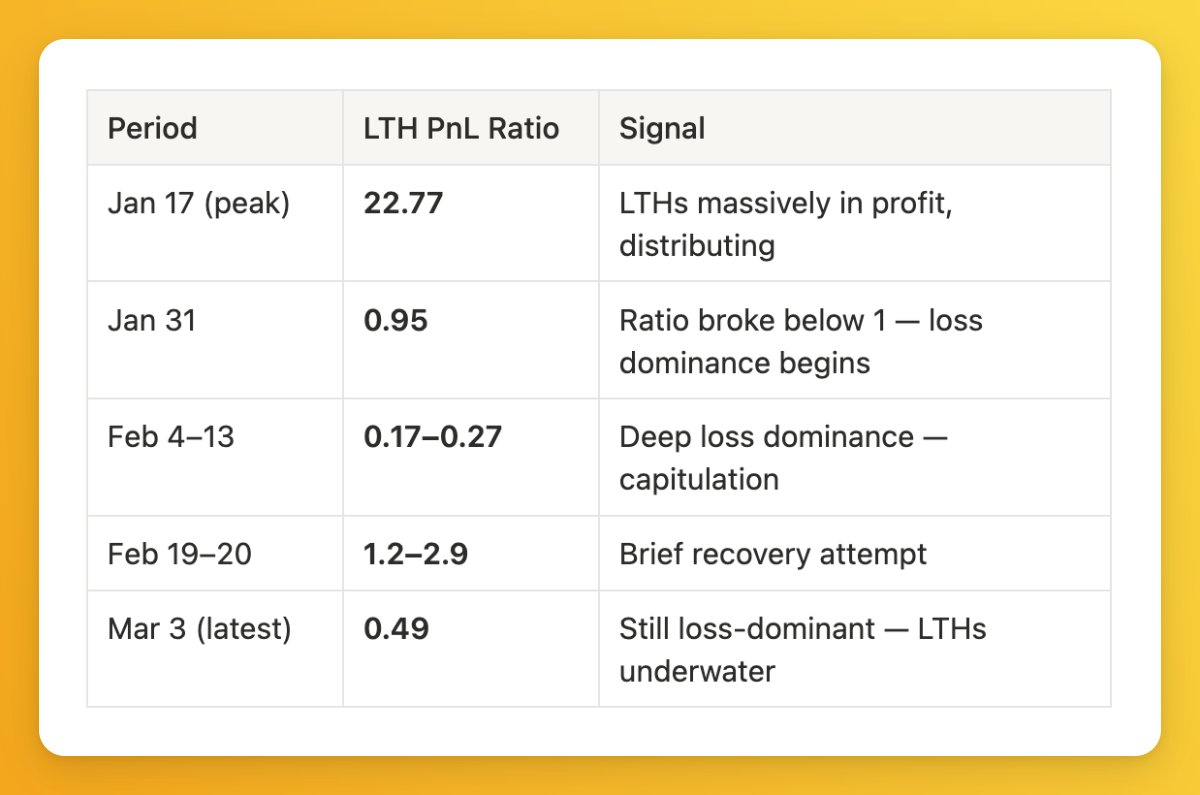
The LTH (Long Term Holder) PnL Ratio has been below 1 since late Jan, which means long term holders are selling more at a loss than in profit. Crazy.
In a normal dip, this ratio usually stays above 1 because strong hands are still selling in profit.
→ Jan 17 was peak profit-taking
→ Early Feb was heavy loss-selling
→ In March its still below 1, so the pressure isn’t gone
This market can’t hold upside for long. Hopefully this changes.

⏱️ State of Crypto This Week: Your 60-second review
• Lyn Alden predicts Bitcoin will outperform gold over the next 2-3 years, betting on BTC as gold's recent rally faces diminishing returns.
• FBI arrests son of custody firm CEO over alleged $46M crypto theft from US Marshals Service wallets, made on the island of Saint Martin.
• SEC closes its 3-year case against Justin Sun with a $10M settlement, dropping fraud and securities violations charges against Tron and BitTorrent Foundation.
• IRS proposes mandatory electronic delivery of tax forms for crypto exchange users, removing the paper copy requirement for form 1099-DA.
• X lifts its global ban on paid crypto promotions under new labeling rules, but the ban remains in the EU, UK and Australia.
• February crypto losses drop to $26.5M — the lowest monthly total since March 2025, per PeckShield.
Which story caught your attention the most? 👇

Gemini 说
这是一期由“Day1Global生而全球”出品的深度播客视频,主要探讨了稳定币发行商 Circle(USDC 发行方)近期股价暴涨的底层逻辑、AI Agent 支付的新叙事,以及整个稳定币和加密支付市场的未来格局。嘉宾是前沿科技投资人郑迪。
以下是该视频的详细文字总结:
1. Circle 股价暴涨 70% 的核心逻辑
逼空行情与财报超预期:Circle 刚发布了 2025 年第四季度财报,不仅业绩超出预期,且市场中原本存在大量空头,导致了强烈的逼空(Short Squeeze)行情,股价在几天内从 61 美元飙升至 90 美元以上。
讲述“AI Agent 支付”新叙事:除了单纯的业绩,Circle 在财报会议上极力强调其作为“支付网络(CPN)”的新定位。结合当下大热的 AI Agent 概念,市场非常买单这个“机器与机器(A2A)自动支付”的宏大故事。
2. 业务转型:稳定币发行是红海,支付服务是蓝海
对标 Stripe 的千亿估值:稳定币的纯发行由于门槛降低和监管介入,正逐渐变成红海。未来的利润大头在于基于稳定币的支付服务。Circle 正在全面对标估值超 1500 亿美元的支付巨头 Stripe,希望通过构建 Circle Payment Network (CPN) 切入支付与清算赛道。
打破“管道”宿命:目前,在许多阳光化的支付场景中,稳定币只是法币进出的“过桥管道”,利润被前端支付服务商赚走。Circle 必须自己下场做支付,才能捕获真正的商业价值。
3. AI Agent 支付 (A2A Payments) 的爆发潜力
机器经济的金融基建:未来的 AI Agent(智能体)之间需要互相调用服务、谈判和交易,这需要一种跨国界、跨协议、能实现微支付的高效手段。基于区块链的稳定币支付(如 Google 推进的 A2A 协议)是完美的解决方案。
实时的“微支付税”:未来 AI 模型的每一次 Token 调用都可能伴随着极小额的实时扣费,传统银行系统无法处理这种高频的微支付,只能依赖高性能公链上的稳定币体系。
发展瓶颈(安全层):目前 Agent 支付面临的最大阻碍是“安全层”的缺失。在无法确保资金安全防范 Prompt 注入攻击之前,资金很难大规模交给 AI 自动管理。
4. Circle 与 Coinbase 的深度“附属”关系
不平等的分成条约:Circle 将 USDC 大约 56% 的收益分给了 Coinbase,这导致 Circle 在财务上几乎沦为 Coinbase 的“附属公司”。
极难解绑:Coinbase 全年约 18.8% 的收入来自 Circle。由于历史原因和早期 Coinbase 对 USDC 起步的巨大扶持,两者签署了自动续期的分成协议,Circle 很难单方面修改条件来提高自己的利润占比。
5. 稳定币市场展望:2028 年达 2 万亿美元?
广义稳定币的崛起:美国财政部相关报告和市场共识预测,到 2028 年稳定币市场规模可能达到 2 万亿美元。
增长动力多元化:这 2 万亿不仅包含 USDC 这样的“狭义稳定币”,更可能包括“链上货币市场基金”(如黑石的 BUIDL)和“银行存款代币”。机构和做市商为了赚取利息,正越来越倾向于持有链上基金而非无息的纯稳定币。
6. Tether (USDT) 的隐忧与未来
利润源于监管套利:USDT 去年的百亿美元利润中,很大一部分来自投资比特币、黄金等非合规储备资产带来的增值收益,而非单纯的利息。
转型黄金代币:一旦未来全面合规(例如仅允许投资短期美债),Tether 的暴利模式将不可持续。嘉宾预测 Tether 未来的战略重心可能会转移到黄金代币(XAUT)上。
7. 个人投资者的 AI 进化
AI 作为超级分析师:嘉宾在视频最后分享,他目前绝大部分的行业追踪、数据分析和文章撰写都交给了 AI 模型(如 Claude 3 Opus、GPT-4),一人就实现了过去一个团队的投研产出。
复刻投资风格:他甚至将朋友的投资理念喂给 AI,在突发事件(如地缘冲突)发生时,AI 能够完美预测出该朋友的交易决策(如:不追高黄金原油,抄底算力资产)。

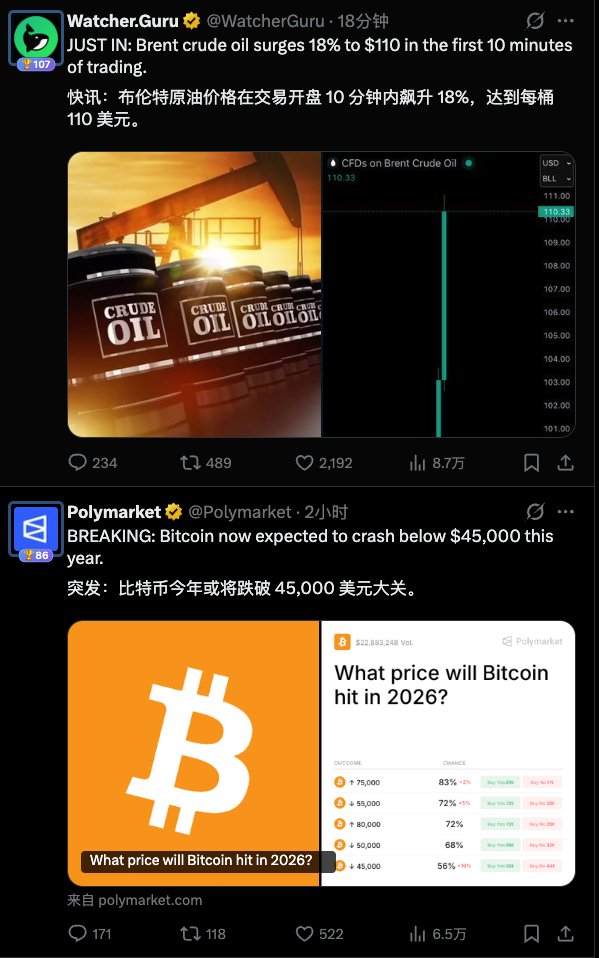
油价狂涨与看跌BTC(更多被当成风险资产)其实是一个逻辑,随着伊朗小电驴在社媒上曝光的增加,外界对美国是否会陷入战争泥潭的担忧也在增加。
Trump在 3 月初表示军事行动将持续 4-5 周。到 2026 年 4 月初,如果伊朗政权未如预期般迅速瓦解,而国际油价持续维持在 110 美元以上,Trump可能会面临巨大的TACO压力。
高油价推高了通胀预期,使得美联储在制定利率政策时陷入两难——如果为了抗击通胀维持高利率,可能会进一步压制已经疲软的就业市场;如果为了刺激经济降息,则可能导致通胀失控。如果两者的结合搞出“滞胀”(Stagflation)来就更可怕了。
当然Crypto也与Trump家族利益息息相关,如果真的BTC去45000,他们家的币圈布局一样会受大损失。
我倾向于Trump会近期就找个合适的机会表达作战“圆满成功”,然后快速结束这场战争。

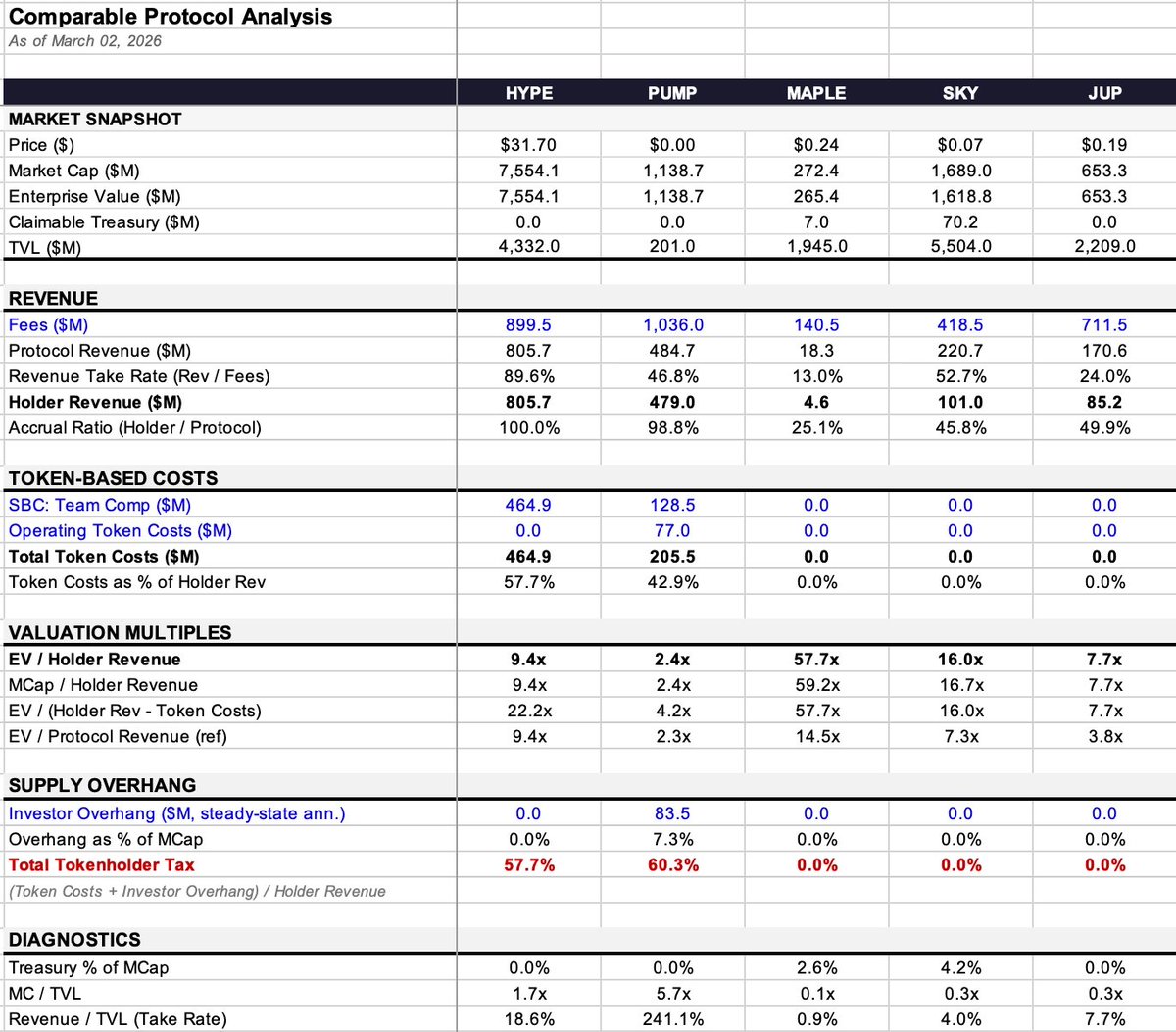
P/E ratios are a fine starting point for crypto valuations, but they miss balance sheets and capital structure.
So I adapted EV/EBITDA from tradfi for tokens. The core metric here is EV/Holder Revenue, or what you're actually paying per dollar that reaches you as a tokenholder.
I walk through five protocols $HYPE, $PUMP, $MAPLE, $JUP, $SKY as illustrations. The spreadsheet link is attached so feel free to swap in your own numbers or play around with it.
This is a prototype, not a finished product. If you find a better way to handle it, please publish it.

Controversial opinion: The biggest reason for the massive disconnect between crypto prices and crypto adoption is that 4 of the top 5 assets (by market cap) are largely uninvestable.
$BTC
- The quantum fear is not going away (even though it's a fairly easy technical fix, it's a much harder governance fix)
- It's not cool to own BTC now that blackrock and JP Morgan dominate it (see rise in $ZEC)
- It's not digital gold (in fact, actual tokenized gold exists)
- It's not scarce (endless derivs and structured products make the 21mm cap useless unless people start using physical bitcoin, which no one does).
- It's not an inflation hedge
- It's not a medium of exchange (stablecoins are)
$ETH & $SOL
- high inflation outweighing any fee capture (this is why market cap goes up while price goes down)
- Infinite blockspace relative to usage, with more L1 competition coming
- Fat protocol thesis on life support (and other than that thesis, no one has ever made a good argument for why L1s actually capture value)
- You need ~1000x more activity / transactions to warrant today's valuations (meaning SOL and ETH are not worthless, it's just VERY hard to justify their current valuations).
(For the record, I'm bullish on both Solana and Ethereum's prospects for further growth (relative to other L1s), I just don't think their tokens capture much value from that growth).
$XRP
- Literally the opposite of good token design. The token does absolutely nothing, and has virtually no linkage to Ripple
- Ripple sells ~$3-4 billion of XRP tokens per year to fund equity repurchases (people argue all day about the efficacy of token buybacks, yet no one seems to care that Ripple dumps tokens to buyback their own stock?)
This is why crypto is so broken. The entire industry was built on 4 assets that all suck as investments, which is why all of the exchanges and brokers cater only to fast money traders and macro funds/CTAs instead of real fundamental investors (even though fundamental investors make up the majority of the investor world).
Of these 4 assets, I'd say i'm most likely wrong about $BTC simply because it is entirely narrative/faith based, and that can change on a dime, plus BTC always goes up eventually. I find it impossible to underwrite Bitcoin as an investment, but I do understand why others like it.
Can this change? I hope so. It's very hard for an industry to grow when the top assets go down, but not impossible. It would require massive rotation (which is what we're seeing in equities right now -- a rotation out of Mag 7, private credit, and tech and into healthcare, energy, etc).
IMO, there are a LOT of good crypto investments right now that accrue value via the adoption of crypto and blockchain. Aligning your investments with the actual growth areas should work. Almost all of the growth and adoption of crypto and blockchain is happening in 3 financial areas:
1) Stablecoin/payments - harder to invest in pure plays, but there are some private stocks
2) DeFi -- tons of ways to capture this growth via equity-like tokens
3) RWA tokenizaton - while most of this value accrues to middlemen like Securitize and Blackrock, there are some pure plays as well.
If this industry pivots away from BTC ETH SOL XRP and memecoins, and into the stocks and equity-like tokens that fuel the growth of DeFi, payments and RWAs, then price will start matching adoption.
I think it's healthy for us in the Ethereum world to have a more bold and open mindset to many things, particularly on the application layer and on how we see ourselves in the world.
We should not compromise on core properties: censorship resistance, open source, privacy, security (CROPS). We should not have "open mindedness" of the type that leaves people with no confidence of what security properties the L1 will still have one year from now. We should not ask ourselves questions like "do we really need light clients to be able to trustlessly verify correctness of the chain?". But especially on the layer of applications and Ethereum's interface to the world, we should be more willing to radically rethink various concepts and step outside our comfort zone.
This includes issues of technological direction, eg. "what if AI basically means that wallets as browser extensions and mobile extensions are dead within a year?"
One example last year was the shift to thinking about privacy as a first-class consideration, something we value equally to the other types of security. This implies a radically different Ethereum application stack, because the entire stack so far has not been built around privacy. Great, let's build a radically different Ethereum application stack!
An example this year is the growing work on the networking side of privacy, both inside the EF and outside.
It includes application-layer issues, eg. "what if the rest of defi is basically just universal futures markets on top of a good decentralized oracle and letting users self-organize on top of that?", and "what if the ideal decentralized oracle is just a SNARK over M-of-N small LLMs over zk-TLSes of some major news sites?"
(BTW this is interrelated with the AI issue: one consequence of AI is that it moves "applications" away from being discrete categories of behavior with discrete UIs, and more toward being a continuous space, so "build fewer apps and rely on users to self-organize around them" should inevitably expand as a pattern)
One example this year is rethinking from zero the role of L2s, and what kind of L2s are actually most synergistic and additive to Ethereum.
It also includes culture. This is a big part of "the whole milady thing" for myself, @AyaMiyagotchi and others. Yes, it's a silly meme. Yes, I find the political takes of some milady partisans cringe and sometimes outright bootlickerish (though other milady partisans are quite the opposite). But the core underlying subtext, the message behind the message, is: rip off the suit and tie. If you have your suit and tie on, be willing to grab the nearest wine glass and spill it all over your suit and tie, so you have no choice but to rip it off and reclaim your body's full flexibility and freedom. Actually imagine yourself doing this the next time you get invited to a richpeopleslop formal gala dinner. Take the preconception that you are "respectable", write it down on a piece of paper, crumble it up and burn it. The psychological baptism of doing this leads to the intellectual baptism of unlocking greater creativity and expanding overton windows.
For too long, our algorithm in Ethereum has been: we have this existing ecosystem, what's the logical next step to make it one step better? Now, our algorithm should be: we have this L1 that is amazing and will become more amazing, we have a growing array of tools, both those built within our ecosystem and outside it, what are the most valuable things to build, knowing what we know now? If YOU had to write the section of the 2014 Ethereum whitepaper that talked about applications, and take a first-principles perspective of what makes sense in defi, decentralized social, identity, and elsewhere, what would you write? At least take the step of marking all path-dependence concerns down to zero, pretend for a brief moment that the Ethereum chain today has exactly zero usage and you're the one suggesting or building the first apps, and see what comes out. Do this even if you're the one building today's existing apps. This is how Ethereum can grow back stronger.

why has no lending market explored the idea of making the calculation of interest charged be dependent on the LTV of a loan
the riskier a loan, the higher the interest the borrower pays
afaik only protocol that has smth along these lines is Maker with ETH-A, ETH-B...

Crypto's tough state, brutal truths:
1)
AI poached the talent. Sentiment tanks not from price, but zero new builders. Cypherpunk narrative means not much to genz in the AI gold rush and global space race.
The memecoins mania disillusioned everyone
2)
Post FTX/Luna, we still tolerated grifters & casino culture instead of builders and actual entrepreneurial pragmatism.
Now they're "moving from crypto" (iykyk) to grift elsewhere, good riddance
3) Geopolitics, most westerners are painfully naive. "Credibly neutral" , WEF soyboy chase of UN-SDG era is over.
We've got a decade plus of sovereignty tools, but disconnected from reality's tradeoffs.
Prime example is Tornado ( I was a heavy user btw), it had to evolve into @0xprivacypools so we can exclude DPRK/IRGC without compromising on base-layer integrity. If you want to tolerate the intolerant, you're just champagne socialised Greta 2.0
4) No hype for ICOs/TGEs of L1s/pre-PMF experiments. Projects with longevity have to tie to utility in AI/Space/Longevity/Finance.
Embrace that Stablecoins + ETFs = DeFi consolidating into FinTech.
Reposition or slide into irrelevance

Just in the last 18 months. $1 Billion
How many of the below are winners?
The ones that launched a token:
Eigen Layer - $170m total raise! $500m Series B val → EIGEN now at FDV $350m
Layer Zero - $55m token buy + earlier rounds, $3B Series B val → ZRO now at FDV $1.9b
Babylon - $15m token sale → BABY now at FDV $130m
Walrus - $140m token sale → WAL now at FDV $400m
Jito - $50M strategic raise → JTO now at FDV 270m
Equity:
Phantom - $150m Series C, $3B val
Talos - $45m Series B, $1.5B val
Daylight - $15m
Series A/B:
XMTP - $20m Series B
Halliday - $20m Series A
Towns - $10m Series B
Seeds:
Kairos - $2.5m Seed
Cork Protocol - $5.5m Seed
Votre - $3.75m Seed
Seismic - $10m + $7m Seed
ZAR - $12.9m + $7m Seed
Inference - $11.8m Seed
Bastion Platforms - $14.6m
Shield - $5m Seed
Reflect - $3.75m Seed
TACEO - $5.5m Seed
Poseidon - $15m Seed
PrismaX - $11m Seed
Catena Labs - $18m Seed
KYD Labs - $7.1m
Miden - $25m Seed
Inco Network - $5m Strategic
ORO - $6m Seed
Glider - $4m
Mahojin - $5m Seed
Cambrian Network - $5.9m Seed
Ambient - $7.2m Seed
Legend - $15m Seed
Universal - $9m
Pod - $10m Seed
Merit Systems - $10m Seed
vlayer labs - $10m Pre Seed
OpenLayer - $5m Seed
OpenTrade - $7m Strategic
Loop Crypto - $2m Strategic
Launcher Capital - $4m Seed
Rumi - $4.7m Pre Seed
Oncade - $4m Seed
Sekai - $3.1m Seed
Scrypted - $1.5m Pre Seed
Mbd - $3m Pre Seed
Future Primitive - Strategic
Axal - $2.5m Pre Seed

Kraken Financial 获批美联储主账户,应该是Crypto首例,这个账户的重要性等于Crypto进入美元体系核心网络的门票。
随后美国银行业集体跳出来反对,从这一点来说,这已经威胁到他们的利益。以前,加密公司处理美元业务必须经过银行作为中介,现正在逐渐突破传统金融壁垒。
直接进入美元支付清算系统,不再需要依赖银行了。这个头开了,下一个可能是Ripple?Anchorage?

Noah makes very good points in this article, but I disagree with his defense of chargebacks given how they are structured today.
The thing everyone forgets is that while payment systems that allow chargebacks (like credit cards) protect consumers, they do the opposite to merchants.
The data on this varies, but something like 40 to 60 percent of all credit chargebacks are "friendly fraud", AKA people abusing the feature for something it wasn't meant for.
In what other context do we defend a solution this ripe with abuse? But cards perpetuate themselves due to a complicated mix of sticky behavior and anti-competitive collusion.
If people want insurance for their transactions (which I certainly do) they should just pay for it, like any other insurance. They would file claims much more judiciously if they did. It also doesn't make sense to make your local Deli pay for your loyalty to American Airlines.
Stablecoins are an opportunity to revisit this strange setup, first and foremost by elevating new payment systems that a corporation does not control (unless the network is permissioned).
Certainly if agents start useing stables, as Noah argues, that will open the door for their owners to start to too.
The other wildcard in this debate is whether the US government caps swipe fees like many other countries have. Now that we know Wall Street hates competition and is more than willing to use regulations to harm consumers, it would only be fair.

Whether regulators see crypto exchanges as public infrastructure or not,
And regardless of whether Upbit and Bithumb have done a good job or a bad one over the years,
Forcing the owners of large, established private companies to sell down their stakes is basically socialism.
If exchange ownership caps were the goal, that conversation should’ve happened when exchanges were first being built.
Korean regulators ignored or dismissed crypto for years, and now that the industry is big, they’re suddenly approaching it in a socialist way.
日历
3 月 10 日
数据请求中