


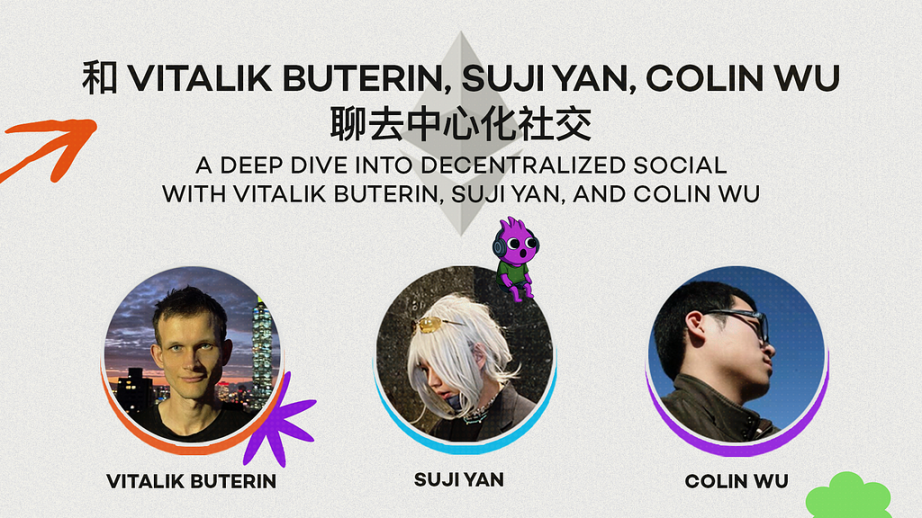
On 23 January, Mask Network, Firefly, and Wu Blockchain Editor-in-Chief Colin Wu co-hosted a deep-dive X Space discussion on Decentralised Social. The conversation featured Ethereum co-founder Vitalik Buterin and Mask Network founder Suji Yan, with open mic participation from the Chinese crypto community.
The discussion explored the current state of decentralised social, its core challenges, and potential future breakthroughs, including integrations with prediction markets and other emerging primitives. Below is a structured summary of the key takeaways.
Background: Twitter Bans and the Catalyst for Decentralised Social
Colin Wu:
Recently, Twitter banned so-called “airdrop farming” platforms, like Kaito. This has reignited discussion around decentralised social products. Vitalik, I believe you have been following this situation. What is your take on this event?
Vitalik Buterin:
I’ve been following decentralised social for several years now. I used Farcaster quite a bit between 2023 to 2024, and I was still using it in 2025. Recently, people have asked why I’m once again focusing heavily on decentralised social. There are two main reasons.
First, X (Twitter) clearly has growing problems. Whether it’s crypto, politics, or other topics, we can all feel the decline in its discussion quality. It’s not healthy for the world to rely on a single global conversation hub. We need alternatives.
The challenge, of course, is network effects. Even if a new social platform has better features, algorithms, or privacy, it’s meaningless without users. Decentralised social products, like Firefly, offer two viable strategies to overcome this. Firstly, separating protocol from clients. Social data, like accounts, posts, likes, reposts, can live on a shared protocol, while different teams build different clients on top. This way, a new app doesn’t start with an empty feed. It inherits the entire social graph across clients, allowing it to compete with large platforms. The second is the aggregator approach, which Firefly represents. Firefly acts as a client for Twitter, Farcaster, Lens, and Bluesky simultaneously. You can participate in Farcaster conversations without fully leaving X. Both approaches meaningfully reduce the network-effect barrier.
The second reason is technological maturity. Firefly, Farcaster, and related projects are fundamentally different from what existed three years ago. Advances in privacy, signaling, and Ethereum infrastructure have made this a much better moment to push decentralized social forward. Combined with recent events, such as Kaito’s ban, Farcaster’s growth, and Lens’ new direction under Suji, it feels like many important things are converging at once.
Colin Wu:
Suji, what’s your view on X’s recent decision to mass-ban these “airdrop farming” platforms?
Suji Yan:
Mask’s collaboration with X dates back as early as 2018. At the time, we were experimenting with crypto-native interactions on Twitter — encrypted tweets, even enabling users to purchase tokens directly within the platform. Jack Dorsey was notably supportive of these explorations, including the idea of turning the very first tweet into an NFT, with proceeds ultimately donated to charities in Africa.
That dynamic shifted materially after Elon Musk’s takeover. While both Jack and Elon advocate for free speech, their philosophies of governance differ fundamentally. Jack believed in gradual change through rules and systems, while Elon favours a far more centralized, top-down approach. In that context, products like Kaito being banned is not surprising to me.
Looking at Lens and Farcaster’s early strategies, I think they were somewhat too confrontational toward X. While X certainly has its issues, the more effective approach is to gradually capture attention and traffic, rather than directly oppose it. Even centralised exchanges like Binance and OKX are building social layers, namely Binance Square, OKX Orbit, yet their integrations with Twitter remain fragmented precisely because X is unpredictable and uncontrollable. That fragmentation underscores why decentralized social infrastructure is necessary in the first place.
However, user migration requires patience, much like the evolution of DeFi and prediction markets, starting with radical experiments, gradually finding balance, and eventually achieving sustainable adoption.
Core Challenge: Why Has Decentralised Social Struggled?
Colin Wu:
Demand for decentralised social is strong as centralised platforms fail to protect user interests. Yet despite countless attempts, from early crypto forums to Friend.tech, Kaito, and Farcaster, few have found true product-market fit. Why has decentralised social remained so difficult to achieve success?
Vitalik Buterin:
I think there are two main issues. The first is still network effects. Over the past decade, even outside crypto, very few new social platforms have truly succeeded.
The second issue is problem misalignment. Many teams start with “We’re crypto. We have tokens and NFTs. How do we add finance into social?” But if you start from social problems themselves, your first thought is never “social needs more money”.
At the core, this is a creator incentive problem. Tokenised social platforms have failed repeatedly because they reward speculation rather than quality. Compare this with Substack, where its top earners are high-quality writers. In contrast, on many tokenised platforms, top earners are usually the already-famous crypto traders or influencers. s
This shows the incentive structures are misaligned. These platforms serve traders, not readers or creators. If decentralised social is to succeed, it must start from social needs, not financial primitives.
Colin Wu:
Vitalik raises a crucial point. Many projects have leaned too heavily into financialisation. Friend.tech is a textbook example. It also reminds me of an early Chinese product called Bihu, where users earned tokens by writing articles. It attracted significant traction for a period of time, but eventually shut down. Another missed opportunity was Mirror. For a period, it effectively replaced Medium and WeChat public accounts within crypto, very much aligned with the Substack-style model Vitalik mentioned, yet it failed to sustain momentum, likely due to team and execution challenges. Suji, how do you see this issue?
Suji Yan:
I think user migration is an inherently slow process and requires a lot of education. If you look back at 2014–2015, many prominent figures in crypto were still using Weibo and WeChat, often in their real-name, without fully realising the risks. It wasn’t until regulatory pressure hit, when accounts were taken down overnight, that users were forced to migrate to X and Telegram.
Today, we haven’t yet seen an equally decisive external shock, which means patience is required. At the same time, our strategy also needs to evolve. We can’t repeat Farcaster’s early approach of aligning too closely with a single player like Coinbase, which discouraged broader participation. What we need instead is neutrality.
With Lens, we’re now taking more of an “alliance” approach. The crypto social market is simply too small for isolated, zero-sum competition. Our goal is to allow all wallets and all chains to post via Lens or Farcaster, transforming deeply crypto-native behaviour, whether it’s debates about insider trading in GMGN comment sections or meme coin interactions, into a shared social experience.
Prediction Markets + Social: An Emerging Convergence
Colin Wu:
Vitalik, beyond decentralised social itself, are there any new or interesting trends you’ve been paying attention to this year? For example, could combining social platforms with prediction markets be a promising direction?
Vitalik Buterin:
This is really interesting. One of Twitter’s biggest improvements this year has been integrating Grok. While it occasionally makes mistakes, overall the quality is quite high. This also highlights an issue with Community Notes. They’re great, but too slow, sometimes taking a full day to appear.
How can we make this faster? Prediction markets might be the only solution. If someone posts an extreme claim, we could instantly create a prediction market, using probabilities to quickly “fact-check” in real time. Right now, many prediction market platforms chase traffic by introducing bets unrelated to truth, which strays from their original purpose.
So, creating an interface that combines high-quality social discussion, AI assistance, Community Notes, and prediction markets could be extremely valuable. Another fascinating idea is Glen Weyl’s Quadratic Prediction Market, which combines market mechanisms with identity systems. While this is difficult to implement in pure financial markets, social platforms provide an ideal context for it.
Colin Wu:
Thanks. I actually have many more questions for Vitalik and Suji, but due to time constraints, and since Vitalik expressed a desire to engage with more members of the Chinese community, we’ll open the floor to questions. You’re welcome to speak up or leave your questions in the comments.
Suji Yan:
I’d like to add something interesting. Speaking of prediction markets, several of the founders and executives at major prediction platforms speak Chinese. For example, a friend (Stanford dropped out) is at Polymarket, Kalshi has John Wang, and the founder of Opinion Lab is also in this circle.
Forrest (Opinion Lab):
I’m excited to discuss the intersection of decentralised social and prediction markets. Our project is called Opinion because we believe that individual opinions and insights are a critical component of prediction markets. They help drive price discovery, which in turn supports liquidity. Beyond liquidity and brand awareness, each participant’s opinion plays a vital role in this feedback loop.
Vitalik mentioned that we may need multiple prediction markets in the future. Given that Polymarket already exists in the West, should there be a market of similar scale for the East? Even for the same event, prices on Opinion and Polymarket may differ, reflecting cultural differences between Eastern (or offshore) users and American users. These differences in understanding generate meaningful variations in price discovery, which is highly valuable and worth exploring on a social level.
So my question is: Should the world really have only one prediction market, or should there be distinct markets for the West and East, each representing different cultures and languages?
Vitalik Buterin:
That’s a very interesting question. I think the answer depends on whether the Chinese and Western communities actually have different needs for prediction markets or whether, in reality, everyone just wants something similar. I’m not entirely sure yet.
What I do hope for is more competition and experiments in the prediction market space. Whether it’s different market designs, different application contexts, or experiments that combine prediction markets with prediction-based governance (Futarchy), all of these should be explored in parallel. We don’t know which model will ultimately work best-and that’s exactly why we need many attempts.
Colin Wu:
Alright, next question comes from Yuxin.
Yuxin:
I’m a contributor at Firefly, and I strongly agree with Vitalik’s points on Community Notes, Social Graphs, Social Identity, and Prediction Markets. These are also my main focus for 2026, essentially Social Trading. I’m currently working on an oracle for a prediction market. I have two questions:
- Nikita, X’s former product lead, once said that in the future users could type a ticker to directly buy a token. Could X eventually match prediction market bets in the News Feed, allowing users to purchase directly?
- If Firefly wanted to implement this, what advantages would it have over X?
Additionally, regarding Futarchy and DAO governance, suppose we form a small social group based on social identity (e.g., only EF Developers) and launch a bet, such as “Should the Cancun upgrade be delayed?” Is this kind of social governance something that only decentralised platforms can execute effectively?
Vitalik Buterin:
This kind of deep integration is very interesting, and there are many possibilities we could experiment with today. For example, on a post, in addition to likes and shares, you could add an “I agree / I disagree” option with probabilities displayed alongside. Running more experiments like this would be very valuable.
Regarding DAO governance, there isn’t currently a dedicated, effective social platform for it. Most governance discussions still happen on Crypto Twitter or in private groups, which creates a lot of inefficiencies.
We need to consider building a new social media interface specifically designed to help protocol or DAO members collaborate, discussing and improving governance. While there are many ideas, such as integrating POAPs or LLMs, there is currently no platform that seamlessly combines discussion with on-chain voting and execution.
Decentralised Social Ecosystem Related Perspectives
Suji Yan:
I see that Mr Luo is here. He’s a dedicated fan of Base and Farcaster, and one of the few Chinese users who deeply appreciates both protocols. Mr Luo, please feel free to ask a question, especially regarding social protocols and their relationship with large tech companies, or recent developments.
0xLuo:
Hello everyone. I’d like to ask Vitalik about the recent trend of combining social protocols with wallets. Both decentralised platforms and centralised products like X are adding financial transaction features. Decentralised aggregators like Firefly are also trying to integrate wallets to allow users to trade prediction markets. How do you view this trend of “social products becoming wallet-enabled” and “wallets becoming social”?
Vitalik Buterin:
The key point, I think, is that the underlying social protocols should remain minimalistic. If a platform is “attention-hungry” or over-optimised for a specific use case, adding too many complex features, it becomes difficult to maintain shared network effects.
I don’t want to see every wallet developing its own incompatible social network. One of Ethereum’s major successes is that wallets are interchangeable. You can use one wallet, and if you don’t like it, you can simply move your private key to another, or even a third. Preserving this flexibility is crucial.
At the same time, as privacy becomes increasingly important, wallets are not only protecting assets but also user data. If you add another layer on top of social, then ensuring interoperability is critical.
Integrating social and financial features at the interface level is feasible, for example, making it easier for readers to tip authors. Another key point is that many decentralised social users today are not yet Ethereum (native onchain) users. Providing them with an integrated, auto-generated wallet, rather than requiring them to learn MetaMask, Rabby, or manage seed phrases, significantly lowers the barrier to entry. Of course, if users want to migrate their account later, we must provide that option.
Colin Wu:
Let me add a point. Vitalik, what’s your view on products like Binance Square? Some jokingly call it the most successful crypto social platform today. Even though it’s centralised, it attracts mostly grassroots users with trading-focused discussions, and sometimes content that involves market manipulation or scams. What’s your view on exchanges building social products?
Vitalik Buterin:
I’ve taken a brief look at Binance Square. In principle, there’s nothing wrong with companies building social platforms. It’s actually unhealthy for the whole world to rely on a single social network. Transitioning from one centralised social network to 100 different centralised platforms, each serving its own community and use case, is already an improvement over the status quo.
The next step is interoperability. If everyone operates on a shared protocol, even if they use different social brands or interfaces, they can still see and interact with each other’s content. If there’s a high-quality decentralised social platform, I might even integrate it into the comment section of my own blog.
If decentralised social succeeds, in the future we could have many companies, governments, and projects with completely different interfaces, all built on the same underlying protocol.
Regarding interoperability, we need to think deeply. It doesn’t always have to be zero friction. If you want your community to maintain a unique culture or vibe, it makes sense to set small barriers. Overall, though, the advantages of interoperability are substantial, and we need to find the best way to implement it.
Suji Yan:
Next, let’s hear from Jocy, a well-known investor in the space. What’s your perspective? Would you still invest? Do you find this industry a bit confusing?
Jocy:
Thanks for having me. Yesterday, Colin and I were discussing why decentralised social products haven’t succeeded. We’ve seen a similar pattern in gaming, they often fail too.
In the current AI cycle, AI has expanded the scale of online applications by 10 to 100 times, which means users’ attention is now even more fragmented. Many people are asking whether decentralised social is even a viable proposition. In 2023, attention was at its peak, so people were willing to build Layer 2 solutions and decentralised products. Today, attention is weaker, which makes building mass-market social apps much harder.
From our fund’s perspective, competing directly with mainstream consumer apps is very difficult. We prefer to first serve crypto users, creating a successful niche product (like Polymarket, even though it’s more financial), or focus on B2B products (like Grass or Scale AI) that have clear revenue models.
So my question to you, Vitalik, is: in today’s market, what kind of founders are more likely to succeed building decentralized applications? And how can the industry bring attention back and convince strong builders and talent to stay?
Vitalik Buterin:
I think blockchain social platforms share a common reason for failure with blockchain games: overthinking. Teams often start with “We’re in crypto, we can do financial stuff. How do we integrate finance into this?” Rather than asking, “What does this application actually need? What are the current shortcomings, and how can we use our technology to solve them?”
Many blockchain games in 2021 seemed successful, but when the 2022 bear market hit, users disappeared. They weren’t there because the games were fun. They were there to make money. Social platforms face the same problem.
I believe the next generation of founders best suited to build decentralised social are those who deeply understand social problems. Someone who understands social dynamics but not blockchain might actually do better than someone who understands blockchain but not social behaviour. Blockchain should operate in the background as infrastructure.
Both social and financial systems today have many problems, and decentralisation can help address them. But it’s crucial to separate decentralized technology from token speculation. If you focus on using blockchain as a data storage layer to solve real user pain points, your product is much more likely to succeed.
Advice to Builders and the Chinese Developer Community
Jocy: I’d like to follow up. The crypto culture gap between China and the U.S. is growing. In the U.S., the focus is more on protocols and infrastructure, supported by a strong developer culture. In China, the ecosystem is more exchange-driven, and large-scale protocols rarely emerge. With the current AI wave, Chinese talent is leaving crypto more decisively than in the U.S.
From a leadership perspective, what advice do you have for Chinese developers? How can we restore confidence and encourage them to continue building decentralised protocols?
Vitalik Buterin: I’ve always thought one of the strongest points of Chinese developers is their UX expertise, their ability to attract large user bases and provide excellent service. Their backend capabilities have also improved significantly.
My advice is that, at this stage, you don’t need to build your own Layer 1 or complex infrastructure. You can leverage existing tools. Focus on what you excel at: solving frontend problems and improving user experience.
For example, you don’t need to build a Farcaster protocol from scratch; you can build a Farcaster client or something like Firefly. Heavy, open-source protocol work is resource-intensive, and since the foundation already exists, Chinese developers can create the most value at the application layer, enhancing usability and user experience.
Closing Thoughts
Decentralised social is reaching an inflection point, where technology is mature, strategies are clearer, and the focus has shifted from token incentives to solving real social problems: data sovereignty, speech environments, creator economies, and open networks.
This long-term vision, bridging Web2 and Web3 through gradual, open migration, is what the Mask team has pursued for nearly a decade. Recent milestones, from the transitions of Farcaster and Lens, to Mask stepping in, to Firefly’s continued innovation, signal a shift from raw infrastructure toward fully-formed, mainstream-ready decentralised social applications.
【免责声明】市场有风险,投资需谨慎。本文不构成投资建议,用户应考虑本文中的任何意见、观点或结论是否符合其特定状况。据此投资,责任自负。