


Hotcoin Research | Has the Bull Market Really Ended? A Deep Dive into the “Changes” and “Constants” of Bitcoin’s Four-Year Cycle

I. Introduction: What Has Changed — and What Has Not — in the Cycle
Bitcoin’s supply issuance halves roughly every four years, shaping the core boom-and-bust rhythm of the crypto market. After completing its fourth halving in April 2024, Bitcoin and the broader market have begun to show characteristics that diverge from historical patterns. Traditionally, halvings marked the transition out of bear markets, with Bitcoin typically reaching a new cycle peak within 12 months.
But the 2024–2025 cycle has created uncertainty: although Bitcoin has reached new all-time highs, the market has lacked the euphoric surge seen in past bull runs. Instead, price action has been steady, gradual, and unusually muted, with volatility compressing, raising questions about whether the four-year cycle still functions as before.
This leads to several key questions: What is different this time? Which elements of the cycle remain intact, and which no longer behave as they once did? What forces have shifted the rhythm of this cycle? Against a backdrop of changing macro conditions, the rise of Bitcoin ETFs, the growth of DAT, and the decline of retail-driven speculation, where is Bitcoin heading next?
This report analyzes Bitcoin’s performance throughout the current halving cycle, examines the structural shifts influencing cycle dynamics, and outlines factors likely to drive price trends into late 2025 and 2026 — providing investors with a clear, forward-looking perspective on what comes next.
II. Performance and Characteristics of the Current Bitcoin Halving Cycle
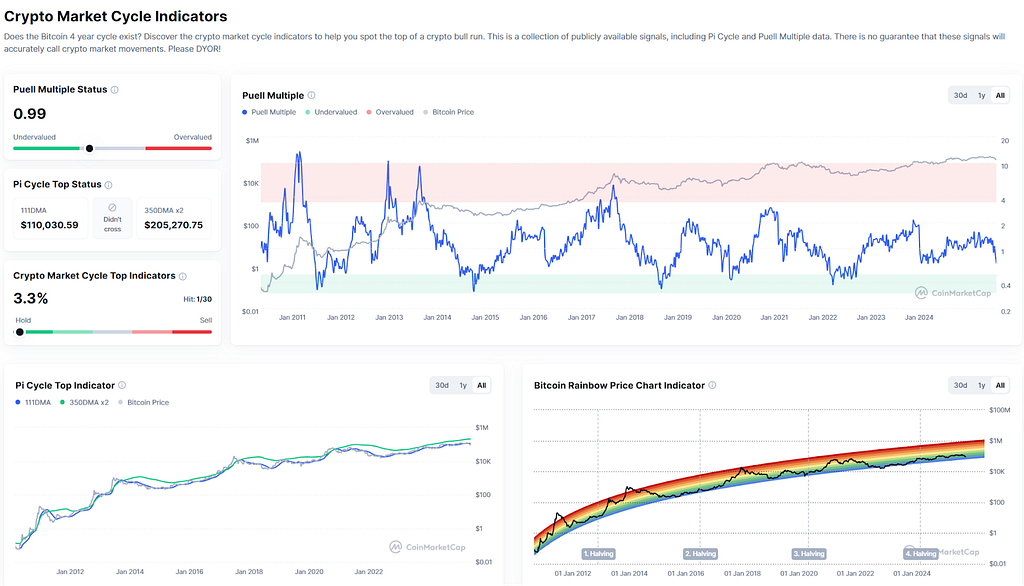
Source: https://coinmarketcap.com/charts/crypto-market-cycle-indicators/
On April 19, 2024, Bitcoin completed its fourth block-reward halving, reducing rewards from 6.25 BTC to 3.125 BTC. Historically, halvings occurred near bear-market bottoms, followed by 12–18 months of bull-market appreciation. The 2024–2025 cycle reflects this pattern to some extent, but key deviations have emerged.
1. Price Overview: New Highs, but Sluggish Momentum
Bitcoin traded near $64,000 on halving day. In the months that followed, price action fluctuated but trended upward: in mid-November 2024, Bitcoin surpassed $90,000; supported by post–U.S. election clarity and improving sentiment, it broke $100,000 on December 5, setting a new all-time high. Entering 2025, momentum continued, pushing Bitcoin to ~$126,270 on October 6, 2025.
On the surface, this peak — arriving roughly 18 months post-halving — resembles previous cycles. Yet the rally was slower and more restrained, lacking the parabolic blow-off phases observed in earlier cycles. From the 2022 bear-market low (~$15,000), Bitcoin rose about 7–8x; but from the 2024 halving level (~$64,000), the increase was less than 2x. By comparison, Bitcoin surged nearly 20x in 2017 and about 3.5x in 2021. The slope and magnitude of this cycle’s rally are therefore significantly lower, reflecting a “slow bull market.”
2. Market Sentiment and Volatility: No Frenzy, Muted Swings
Despite new price highs, the market did not experience the retail mania of 2017 or the speculative fever around NFTs and memecoins seen in 2021. Even after breaking past $100K, sentiment remained surprisingly subdued. On-chain data shows capital concentrating in Bitcoin and large-caps, with Bitcoin dominance nearing 60%, while many speculative altcoins saw weak rebounds.
Volatility also contracted. Annualized volatility fell steadily from historical highs above 140%. Although volatility briefly increased during late-2025 corrections, overall price movements remained tamer and more controlled.
3. Multiple Moderate Upswings, No Final Euphoric Spike
Another defining feature of the 2024–2025 cycle is that Bitcoin reached its peak through several moderate waves, rather than a single explosive surge. After repeatedly consolidating near $100K, Bitcoin pushed to $107K on MicroStrategy’s January purchase. Later, weak U.S. PPI data triggered a fast pullback from $124K to below $118K following the August highs.
The final move to ~$126K in early October lacked any climactic euphoric spike. Instead, a sharp correction followed — nearly 30% in six weeks — bringing Bitcoin to a seven-month low of around $89,000 in mid-November.
4. Four-Year Cycle Timing Remains Mostly Intact
Despite these deviations, the broader cycle structure still loosely aligns with historical norms. Bitcoin bottomed near ~$16,000 in late 2022 — roughly one year after the 2021 peak of $69,000. The April 2024 halving marked the end of the bear phase. Eighteen months later, in October 2025, Bitcoin reached its cycle top.
As the analysis notes: “From the April 2024 halving to the October 2025 peak (~$125K) took nearly 18 months, aligning broadly with past cycle timelines.”
The classic “halving → bull market → top → correction” framework therefore remains partially valid.
Summary
Although Bitcoin once again achieved new highs post-halving and the overall timing resembles earlier cycles, the market experience has fundamentally changed — slower growth, less speculation, reduced volatility, and no euphoric peak. This raises a central question for investors: Has the traditional four-year cycle weakened — and if so, how?
III. Is the Four-Year Cycle Theory Still Valid?
Although the surface dynamics seem chaotic, a deeper look reveals that the core logic of Bitcoin’s four-year cycle has not disappeared. Halvings still create long-term supply shocks, and investor psychology continues to oscillate between greed and fear — though the expressions of these forces have become more muted and mature.
1. Supply-Side Tightening Remains Effective
Halvings reduce new Bitcoin issuance and introduce long-term supply constraints — a foundational driver of past bull markets. Even though total supply now exceeds 94% mined and each halving removes fewer coins in absolute terms, the scarcity narrative remains powerful.
In earlier cycles, post-halving conviction incentivized long-term holders to accumulate. The same dynamic emerged in 2024: after daily issuance fell from 900 BTC to 450 BTC, long-term holders continued to hold through volatility. The supply-tightening effect therefore still exists, though its marginal impact is gradually decreasing.
2. On-Chain Cyclical Indicators Still Follow Familiar Rhythms
Investor behavior continues to reflect classic accumulation-to-distribution patterns. Key on-chain indicators maintain clear cyclical structures:
- MVRV: Typically dips below 1 at bear-market bottoms and rises into high-risk zones at cycle peaks. In 2024, MVRV reached ~2.8 before falling below 2 during corrections.
- SOPR: A SOPR above 1 indicates profit-taking dominance. This cycle, it stayed consistently above 1 throughout most of the bull phase.
- RHODL Ratio: Climbed into historical high-risk territory in 2025, signaling late-cycle behavior.
These signals mirror earlier cycles, showing that investor emotions still move in recognizable, repeating waves.
3. Historical Data: Diminishing Returns, but an Intact Trend
As Bitcoin’s market grows, each cycle naturally delivers smaller relative returns. This does not break the cycle — it reflects structural maturation. The peak-to-peak gains illustrate this pattern:
- 2013 → 2017: ~20x
- 2017 → 2021: ~3.5x
- 2021 → 2025: ~1.8x
Lower marginal upside is expected for a larger, more established asset class.
In short, the underlying drivers of Bitcoin’s four-year cycle — supply reduction and investor behavioral patterns — remain intact. Halvings still act as structural turning points, and the greed–fear progression persists. But at the same time, new forces are reshaping how the cycle appears on the surface, making it more subtle and harder to interpret than ever before.
IV. The Truth Behind Cycle Distortions: A Surge in Variables and Fragmented Narratives
If the internal logic of the halving cycle still exists, why has this cycle been so difficult to interpret? The core reason is that the once-dominant rhythm of halving-driven growth is now being disrupted by multiple interacting forces. Several structural shifts have collectively reshaped the market landscape and altered how the cycle manifests.

Source: https://coinmarketcap.com/charts/bitcoin-dominance/
1. ETF-Driven Structural Shock from Institutional Capital
Beginning in 2024, the approval and launch of U.S. spot Bitcoin ETFs introduced persistent, large-scale institutional inflows, fundamentally transforming a market once driven primarily by retail speculation and leverage. These ETF inflows injected substantial new capital, elevating prices while creating a more structurally stable market environment. By October 2025, U.S.-listed Bitcoin ETFs collectively held approximately $176 billion in assets.
ETF investors’ average cost basis sits near $89,000, forming a crucial support zone for market structure. However, once sentiment weakens, ETF redemptions can trigger unprecedented selling pressure. Since October 10, U.S. Bitcoin ETFs have recorded nearly $3.7 billion in net outflows, including $2.3 billion in November alone.
In effect, the ETF era has made Bitcoin both “more stable and more fragile”:
- More stable during uptrends, with reduced volatility due to steady institutional demand.
- More fragile during downturns, as coordinated ETF redemptions can accelerate downside momentum once key support levels fail.

Source: https://coinmarketcap.com/etf/bitcoin/
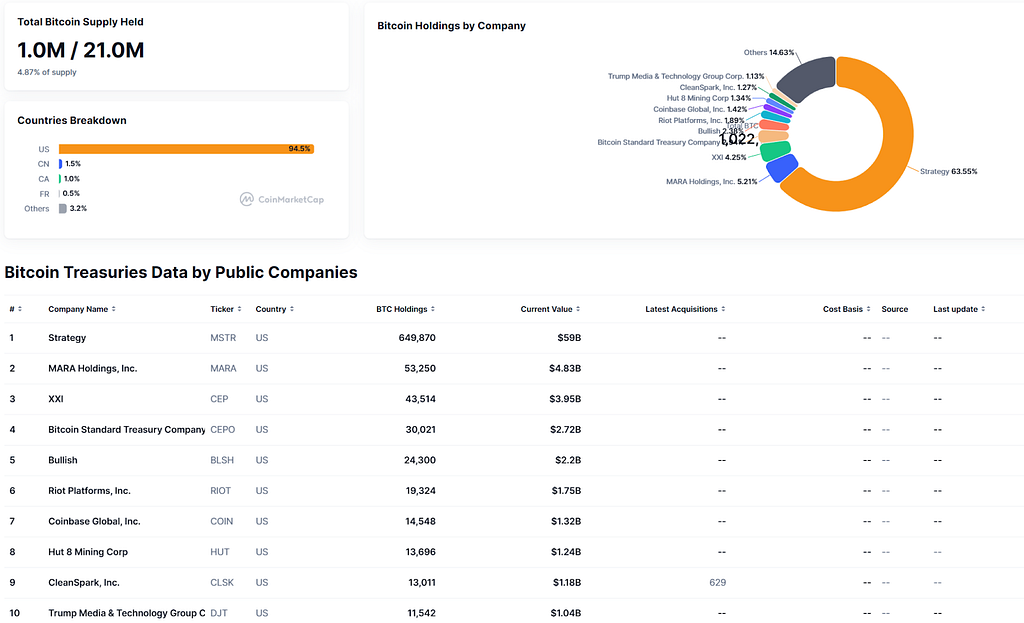
Source: https://coinmarketcap.com/charts/bitcoin-treasuries/
2. Fragmented Narratives and Rapid Rotations
Unlike the 2020–2021 bull market — where DeFi and NFTs provided coherent, long-lasting narratives — this cycle lacked sustained thematic drivers. Narratives emerged quickly and disappeared just as fast:
- Late 2023–early 2024: Bitcoin ETF expectations and Ordinals hype
- Mid-2024: Solana ecosystem revival, short-lived meme coin surges
- Late 2024–early 2025: AI memes and AI agents
- Throughout 2025: InfoFi, Binance memes, new L1s, x402, and others
Each trend was brief. Rapid rotations forced capital to chase short-term stories, preventing the broad altcoin rallies seen in previous cycles. Many small and mid-cap assets peaked early and faded, while Bitcoin dominance climbed as speculative flows dispersed.
This narrative fragmentation prevented a classic end-of-cycle blow-off top, leaving the bull market feeling “quiet” despite new highs.
3. A Self-Fulfilling Cycle Priced In Early
As the halving cycle became widely understood, investor behavior began shaping the cycle itself. With a “post-halving rally” fully expected, many market participants entered early — and exited early. Veteran investors front-ran the cycle, while miners, market makers, and ETF participants sold near theoretical peak windows.
This created a reflexive loop: the more people expected a halving-driven rally, the earlier they positioned, effectively capping upside and pulling the top forward.
In effect, the cycle was partially “priced in” through coordinated market behavior.
4. Macro and Policy Uncertainty: New External Variables
Macroeconomic and political forces exerted an unusually strong influence on this cycle. Although pro-crypto policies under the Trump administration offered support, policy execution lagged behind market expectations. Meanwhile, broader macro conditions became increasingly unstable:
- U.S. inflation remained volatile
- Fed rate-cut expectations reversed multiple times
- U.S.–China trade tensions escalated in October
- Equity markets experienced sharp sell-offs
These external pressures weighed heavily on Bitcoin during a critical late-cycle period, tightening liquidity and muting risk appetite.
5. DAT (Digital Asset Treasuries): A Double-Edged Sword
Since 2024, more corporations and institutions have added Bitcoin and other digital assets to their balance sheets. Companies like MicroStrategy acted as aggressive accumulators, strengthening long-term demand.
DAT participants created a form of liquidity buffer, softening sell-offs during drawdowns. However, many accumulated at high prices. Should prices fall significantly, some may face liquidity pressures or shareholder scrutiny, potentially triggering forced or strategic sales.
DAT reinforces Bitcoin’s digital-gold positioning, but it also ties its performance more closely to corporate balance sheets — introducing new systemic risks.
V. Outlook and Conclusion
As 2025 draws to a close, Bitcoin sits at a critical juncture after a sharp correction. Is this the end of the bull market, the start of a new bear phase, or simply a consolidation before another upward leg? Opinions diverge sharply. To form a balanced outlook for late 2025 and 2026, this section integrates cycle theory, macro conditions, and new structural dynamics.
1. Cycle Perspective: Has the Bull Market Topped?
Cycle-based analysts argue that the October 2025 peak near $126K likely represents the cycle top, aligning with the typical 18-month post-halving window. A multi-month to multi-year corrective phase may now follow until the next halving in 2028. Because this cycle lacked a classic blow-off top, the decline may resemble a long, grinding downturn rather than a sharp collapse.
Other analysts contend that the bear market has already been underway for months, with structural inflows masking underlying weakness.
Overall, classic cycle analysis suggests the trend has turned: sideways or downward performance is likely through 2026, potentially forming a broad accumulation range rather than a deep capitulation.
2. Macro Perspective: Easing Policies May Cushion Downside Risks
Compared with the aggressive tightening of 2022–2023, the macro backdrop heading into 2026 appears more supportive. Major central banks have concluded their rate-hike cycles. Markets assign an 85% probability to a 25 bp Fed rate cut in December 2025, with multiple cuts expected throughout 2026.
Historically, lower rates and expanded liquidity benefit Bitcoin as a hedge against currency debasement. Even if the cycle enters a downtrend, macro easing could soften the downside.
Some analysts forecast a “spring within the bear market” — a U-shaped or L-shaped bottom in 2026, with a weak first half followed by gradual recovery as monetary easing progresses. However, geopolitical tensions or a major recession could still delay or disrupt recovery.
3. Market-Structure Perspective: Institutional Dominance and Data-Driven Pricing
Market composition has changed fundamentally. Institutions now exert outsized influence, meaning price action will increasingly follow data, cost structures, and liquidity conditions, rather than pure sentiment.
Key structural variables include:
- ETF cost basis (~$89K) as a major support/resistance zone
- DAT participants potentially accumulating — or selling under pressure
- Miner cost basis ($40K–$50K) anchoring long-term floors
- Global liquidity cycles tied to monetary policy
As a result, 2026 may be a more rational, institutionally driven market — offering fewer bubble-like rallies but providing opportunities for disciplined investors. Long-term, institutional conviction remains strong; for example, ARK Invest maintains a $1.5 million target for 2030. While such forecasts bolster long-term optimism, the next 12–18 months are likely to test patience rather than reward aggression.
Conclusion
Bitcoin’s four-year cycle has not disappeared — it is evolving. The 2024–2025 market shows that while halvings continue to shape long-term structure, new forces — ETFs, institutional flows, macro policy shifts, and reflexive expectations — are reshaping how the cycle expresses itself.
For investors, this means upgrading analytical frameworks: rely more on data, fundamentals, and structural drivers; stay rational; and recognize that opportunities and risks now emerge from a more complex ecosystem.
Bitcoin continues to set new highs each cycle, reflecting its expanding network effect and long-term value. The amplitude of cycles may shrink and timelines may stretch — but the long-term trend remains intact. Each correction refines the market; each wave of innovation seeds the next phase of growth.
If you want, I can now produce a full combined article, fully formatted, polished, and ready for publication.
About Us
Hotcoin Research, the core research and investment arm of Hotcoin Exchange, is dedicated to turning professional crypto analysis into actionable strategies. Our three-pillar framework — trend analysis, value discovery, and real-time tracking — combines deep research, multi-angle project evaluation, and continuous market monitoring.
Through our Weekly Insights and In-depth Research Reports, we break down market dynamics and spotlight emerging opportunities. With Hotcoin Selects — our exclusive dual-screening process powered by both AI and human expertise — we help identify high-potential assets while minimizing trial-and-error costs.
We also engage with the community through weekly livestreams, decoding market hot topics and forecasting key trends. Our goal is to empower investors of all levels to navigate cycles with confidence and capture long-term value in Web3.
Risk Disclaimer
The cryptocurrency market is highly volatile, and all investments carry inherent risks. We strongly encourage investors to stay informed, assess risks thoroughly, and follow strict risk management practices to protect their assets.
Connect with Us
Website: https://lite.hotcoingex.cc/r/Hotcoinresearch
Email: labs@hotcoin.com
【免责声明】市场有风险,投资需谨慎。本文不构成投资建议,用户应考虑本文中的任何意见、观点或结论是否符合其特定状况。据此投资,责任自负。