


2020-2021 Cryptocurrency Market Background
COVID-19 has had an unprecedented impact on the global economy, and amid the pandemic, cryptocurrencies have had a positive demand shock across all regions. The global cryptocurrency market is expected to grow from \(1.44 billion in 2020 to \)1.63 billion in 2021, at a compound annual growth rate (CAGR) of 12.9% (ReportLinker, 2021). Grayscale’s 2021 Bitcoin Investor Study (Grayscale, 2021) shows continued growth in interest, awareness and acceptance of Bitcoin and the entire digital currency ecosystem. Specifically, the percentage of people willing or considering investing in bitcoin products rose from 36% in 2019 to 59% in 2021. Increased investor interest in the cryptocurrency market is also reflected in trading volumes. Coinbase, the world’s largest cryptocurrency exchange, achieved rapid revenue growth due to a surge in trading volume. According to the annual report data (Coinbase, 2021), Coinbase’s operating income in 2019-2020 increased from US\(534 million to US\)1.3 billion, a year-on-year increase of 139.14%; the net profit turned losses into profits, and the net profit before tax in 2020 was 409 million Dollar. Coinbase Q3 2021 net income was \(1.2 billion, more than four times of what was achieved a year ago. However, that figure was down from more than \)2 billion in the second quarter. Coinbase (2021) reported that Bitcoin accounted for 19% of transaction volume and Ether accounted for 22%. The remaining 59% came from other crypto assets, which were up from 50% in the second quarter. In the short term, under the influence of the epidemic in 2020, the decline in economic stability and the introduction of quantitative easing policies by central banks in various countries will increase the market’s demand for risk aversion and value preservation, driving the price and transaction volume of digital cryptocurrencies led by Bitcoin to rise rapidly. At present, the global epidemic continues, superimposed on the previously announced \(1.9 trillion Economic Relief Bill and \)2.3 trillion Infrastructure Plan announced by the US government, the market expects global inflation to rise, providing momentum for the continued cryptocurrency boom. In addition to purchasing cryptocurrencies and cryptocurrency-related products, investors can also acquire cryptocurrencies from their roots for a long period of time through mining. Mining refers to the acquisition of cryptocurrencies by performing proof of work or other similar computer algorithms. The consensus mechanism is used to verify and confirm transactions on the blockchain, preventing fraudulent transactions or modifications. Because mining is not a labor-intensive industry, theoretically, mining can be done as long as there are mining machines and electricity available. This is the investment method favored by many companies. According to incomplete statistics, as of February 19, 2021, 17 listed companies disclosed that they have purchased Bitcoin mining machines, and 10 of them have disclosed the power of mining machines (close to 21EH/s), including Bitfarms, Marathon Patent Group, Digihost Technology, MGT Capital Investment, etc. In 2020, due to the skyrocketing price of Bitcoin, coupled with the continuing epidemic and chip shortages, the supply of mining machines will be in short supply. In the market, first-hand mining machines have been sold out, and second-hand mining machines are at a large premium. From this point of view, mining has also become one of the popular ways to invest in the cryptocurrency market in 2020-2021. This report will first explain the factors that affect miners’ paper profit as a basis, further analyze the miners’ earnings of mainstream digital currencies and new digital currencies in 2020-2021, how investors are now entering the mining investment market, and finally, introduce mining investment in 2022 Mine potential project.
Factors Affecting Miners’ paper profit
According to the data of glassnode, the daily income (fees + block incentives) of miners this year is almost around 1000BTC. As of the date of this report, being December 14, 2021, the daily revenue of Bitcoin mining was $44.65M, a year-on-year increase of 129.64% compared to the previous year (Ycharts, 2021). The mining of cryptocurrencies has extremely high demands on computing power and energy consumption. Therefore, there are currently small-scale miners in the mining industry who are unable to make profits, and gradually withdraw from the existing incentive system. However, due to the high valuation of cryptocurrencies, a large number of industrial miners with higher computing power and capital-intensive operations continue to profit. This report divides miners’ income into two categories and conducts a funnel-type analysis. The first is the Book Income of miners, which is only affected by the amount of coins mined by miners and the price of coins. The second is the Net Income of mining, which needs to be further considered. There are also relevant cost factors such as electricity, equipment prices, etc. The correlation between the two can be expressed by the formula: Mining Income – Mining Cost = Mining Net Profit The paper profit of miners is directly determined by the amount of mined currency and the price of price-corresponding currency. According to the specific rules of cryptocurrency, the amount of currency is directly related to the computing power that miners can provide, but is not the only relevant factor. Take Bitcoin as an example, the Bitcoin block production speed is constant at one block every ten minutes, and the difficulty of mining changes with the computing power of the entire network (that is, the more computing power available, the more the difficulty of mining will increase accordingly). Therefore, the main factor affecting the number of miners is the ratio of the computing power held by itself to the power of the entire network. The proportion can also be understood as saying that the miner has a higher probability of winning in the competition for online accounting rights. Secondly, the amount of rewards in cryptocurrencies also has corresponding quantitative rules, so the overall correlation can be sorted into the following formula:
In addition to the above factors, the net income of miners also needs to consider cost-related factors, the most important of which is the cost of electricity, that is, the price of electricity, as well as equipment costs, site costs, costs of mining machine and power consumption of the mining machine . The mining of cryptocurrencies requires the output of a large amount of electricity, and the price of electricity is the variable cost that needs to be considered most. The world’s total electricity consumption is about 154,620TWh. The average annual electricity consumption of Bitcoin mining is about 188TWh, which is 0.12% of the global electricity consumption, and even exceeds the annual electricity consumption of some countries (Ssaurel, 2021). The electricity consumption of Ethereum mining is 44.46TWh per year (Beekhuizen, 2021), accounting for about 0.03% of global electricity consumption. Therefore, the consumption of electricity is huge. In addition, the price of the mining machine itself is also a fixed cost that miners cannot ignore. The number of miners and their own computing power also determines the size of their computing power. In general, after excluding the non-direct core cost factors such as site and labor costs. the overall relationship can be integrated as: Unit electricity price * number of miners * power consumption of miners = variable cost Variable cost + mining machine price * number of mining machines (i.e. fixed cost) = mining cost The above is a direct relational expression of miners’ income-related factors, and how each factor is affected requires further analysis. For example, the price of cryptocurrencies, the difference between cryptocurrencies and fiat currencies circulating in various countries is that they are not controlled by any national government or central bank, so their prices will not be directly determined by any individual. An article published by Coinario in 2021 analyzes that the price of cryptocurrencies is generally affected by five factors: supply and demand, production costs, competitiveness, regulatory regimes, and the scale of adoption. Therefore, paper profit of miners will also be affected by various aspects of the macro and micro environment.
Miners’ Reward Trend Of The Old and Emerging Crypto Currencies During 2020 to 2021
2.1 Bitcoin
Bitcoin is one of the most popular and dominant crypto currencies in the world. Because of Bitcoin’s limited number of tokens (the Bitcoin protocol is capped at 21 million), inflation is avoided when it comes to this cryptocurrency. Its “anti-inflation” ability was further strengthened at the end of 2020, and the price has repeatedly hit new highs. It broke through the \(50,000 mark in early 2021, and reached \)66,000 in April this year (Messari, 2021). The rise in the currency price is good news for miners who have a large reserve of mining machines in the early stage, because it makes the investment return cycle shorter, while the mining machine merchants increase the price accordingly at the same time. Investors who purchase mining machines during the period of rising currency prices will increase their mining costs, and their corresponding net reward will be lower than that of miners who carried reserves in the early stage. If the floating indicators such as currency prices are not taken into consideration here, it is noted that from January 2020 to November 2021, the daily reward per hash rate unit of the cryptocurrency Bitcoin indicated in a downward trend, according to the data shown as below.
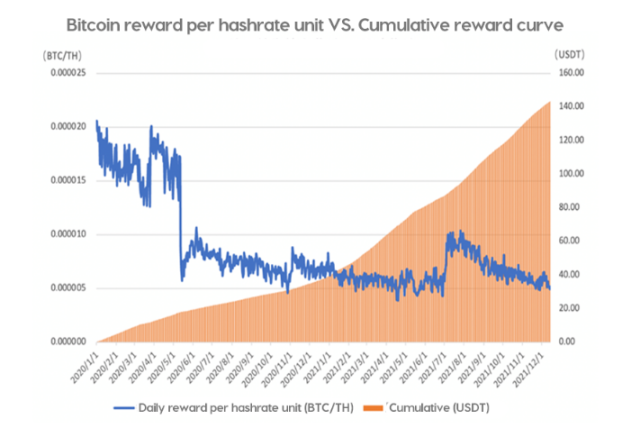
Graph 1: Bitcoin reward per hash rate unit VS. Cumulative reward curve Notes: 1.Daily reward per hash rate unit = Daily mining reward / Daily total hash rate;2.Source: OKeX;3.Bitcoin’s reward unit is: BTC/TH
On May 18, 2021, the People’s Bank of China issued the “Announcement of China Internet Finance Association, China Banking Association, and China Payment and Clearing Association on Preventing the Risk in Virtual Currency Transactions” through its official WeChat account. Afterwards, an announcement was made to ban mining-related businesses in China and enforced a temporary suspension of Bitcoin mining operations in China, which accounted for more than 75% of global bitcoin mining activity at that time. The Cambridge Bitcoin Power Consumption Index (University of Cambridge, n.d.) shows that Bitcoin mining power consumption in China was zero in July. The suspension of Bitcoin mining operations in China may be one of the potential reasons why Bitcoin’s network-wide hashrate dropped sharply from late May to early July, This also corresponds to the phenomenon that Bitcoin’s mining daily reward per hashrate unit has a small step-by-step callback from May to July. It is precisely because of China’s repression on Bitcoin mining, the shutdown of farms, and the decline in the computing power of the entire Bitcoin network that the mining difficulty has also been reduced accordingly, so the enthusiasm of overseas miners has greatly increased. As of December 2021, the latest computing power of the entire network has recovered to 188.9 EH/s, and the daily unit hashrate reward of Bitcoin mining is 0.0000056 BTC/hash.
2.2 Ethereum
Unlike Bitcoin, which tends to function as a payment and store of value, another giant of cryptocurrencies, Ethereum, is a distributed blockchain computing platform for smart contracts and decentralized applications. Users can issue smart contracts and digital currencies on their platform, and “gas” needs to be burned for transactions on the Ethereum platform. Therefore, in addition to mining Ethereum as income, miners can also earn fees by packaging transactions on the chain. The daily reward per hashrate unit of Ethereum mining has a general downward trend from 2020 to 2021. After a slight increase in the daily reward in July this year, it dropped again. As with Bitcoin’s uptrend, the underlying reason for Ethereum’s modest July uptick was a small drop in hashrate due to the temporary suspension of Chinese mining operations.
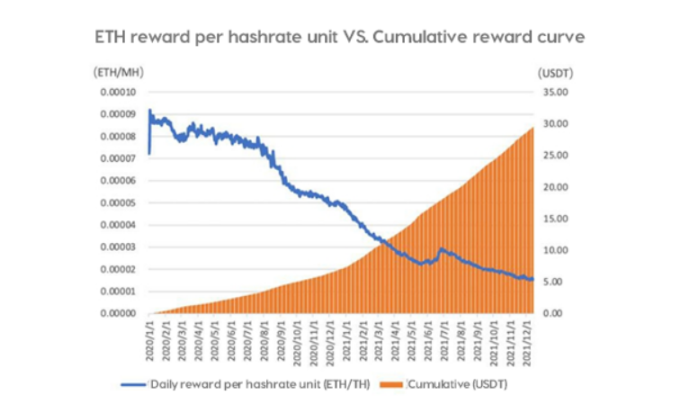
Graph 2:Ethereum reward Per Hash Rate Unit vs.Cumulative Reward Curve Graph Notes:1. Daily reward per hash rate unit = Daily mining reward / Daily total hashrate;2. Source: OKeX;3.Ehereum’s reward unit is: BTC/TH
2.3 Chia
Chia, which just launched last year and was founded by BitTorrent founder Bram Cohen, adopts the Proof of Space and Time to secure the network and verify transactions. The feature of Chia is that it uses the spare space of hard disk to verify the blockchain, reduces the extra cost of mining machines and power consumption, and prevents the waste of resources (Hands, 2021), which is more suitable for ordinary users to participate in. A survey by Hands (2021) shows that Chia consumes 500 times less electricity than Bitcoin and 200 times less than Ethereum. A spokesperson from Chia said in November that the Team is developing a data-sharing prototype for the World Bank’s Climate Warehouse, which is described as a “non-exclusive, open-source and free solution for the public good,” reflecting Chia’s commitment to pursuit of green blockchain. Due to the ease of operation of Chia mining, the daily unit hash income on the Chia Mainnet reaches 0.0774 XCH/TiB. As a large number of miners poured into Chia’s mining market, computing power rapidly increased and daily unit computing power income dropped significantly by 22 times to 0.00349 XCH/TiB in just 3 months. As of November 2021, Chia’s daily unit hash income is 0.00025 XCH/TiB, and the unit hash income at the initial stage of the Mainnet launch is more than 300 times that of the current one.
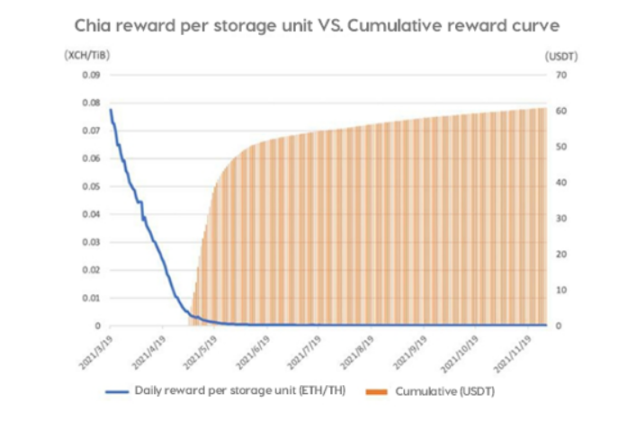
Note:1.The data comes from the XCHSCAN browser.
2.4 Arweave
Arweave is a network created by combining multiple blockchain technologies, trying to connect those who have storage space with those who need permanent storage, so as to achieve a decentralized, censorship-resistant way to permanently store data. Arweave’s PoA (Proof-of-Access) mechanism is generated on the basis of PoW (Proof-of-Work), which solves the problem that PoW requires all nodes to synchronize all blocks to verify the entire data. As the legitimacy of the chain will lead to the expansion of the data scale on the chain over time, it will limit the number of full nodes to a certain extent, and reduce the degree of decentralization and access performance, and other shortcomings. The consensus mechanism of PoA allows miners to start mining without synchronizing the entire chain and only needs to download some blocks, which lowers the mining threshold. The selection of the recall block is based on the hash value and height of the previous block, and if you want to mine a new block, you need to have a recall block for verification. Therefore, the game rules of mining have changed from the previous mechanism of Bitcoin and Chia coin, which simply relies on computing power or storage space to get rewards and distribution: Probability of mining block reward = probability of having historical data x probability of being the first to solve the hash value Therefore, when miners have more storage space for storing past blocks on the chain, they will increase the probability of mining new blocks and getting rewards. In addition, the mechanism of PoA will incentivize miners to store rare blocks, not just those that have been copied perfectly. In this way, the miners who stored the rare block will compete with fewer miners for the same level of rewards in the PoW mechanism. At present, the project has upgraded the PoA mechanism to SPoRA (Succinct Proofs of Random Access), and the purpose of this upgrade is to prevent miners from storing data in cloud servers such as AWS and Google Cloud in order to increase the probability of having historical blocks. In this way, miners are encouraged to use local hardware to store data to prevent the centralization of storage resources. The following picture shows the price trend of AR coin since 2020. It was found that its price had been in the doldrums throughout 2020 without major fluctuation, but since the beginning of 2021, the overall price has shown an upward trend with great fluctuation. In the second half of this year, it was in a relatively high and volatile state. It reached a staged peak in November, and then fell rapidly. As of the date of this report, the price is in a state of recovery. This shows that even in the case of a decrease in unit hash income, the actual income of miners will change significantly due to the fluctuation of transaction price.
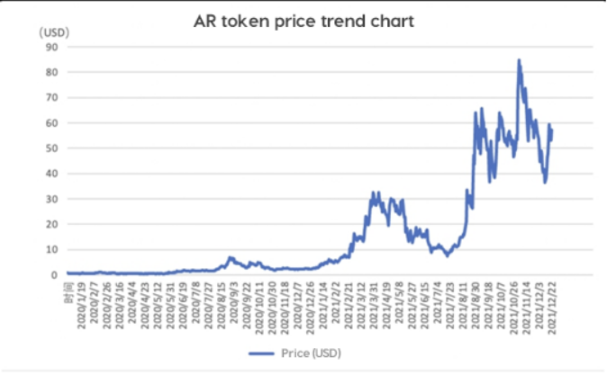
Chart 4: AR Coin Price Trend Chart Note: Data source from Coingecko
2.5 BTC, ETH, CHIA– Monthly Sum of Mining unit Hashrate Daily Average Income
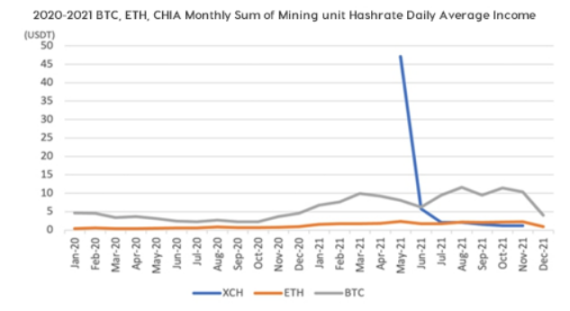
Chart 5: 2020-2021 BTC, ETH, CHIA Monthly Sum of Mining unit Hashrate Daily Average Income.
The above picture shows the monthly total trend chart of the daily unit Hashrate or storage space income of BTC, ETH and XCH, in which the Hashrate unit of Bitcoin is calculated in TH, the Hashrate unit of Ethereum is MH calculation, Chia coin Calculated in TiB of storage space. Because Tether is the dominant trading pair in the central exchange, the following revenue calculations are unified in USDT as the final unit. As the above figure shows, the unit income of Bitcoin has fluctuated. From the beginning of 2020 to October 2020, it showed a steady decline as a whole, from about 4.56 USDT per unit of computing power to about 2.26 USDT, and then began to slow down. in April 2021, it reached a staged high, nearly 9.20 USDT. Since then, it has been in a state of high volatility, and its income has again recently dropped to around 4.0 USDT by the end of this year. In contrast, the unit computing power of Ethereum has little fluctuation with the relatively flat trend and slow rising. But as of the date of this report, there has been a significant decline this month, from the total of 2.22 USDT in November 2020 to 0.92 USDT. The Chia coin has been online for a short period of time, and the corresponding US dollar price has not been released since May 4, 2021, so the Chia image above is short. Chia’s unit storage space income dropped significantly at first, from around 47.12 USDT in the first month to around 5.76 USDT, and then fell further. As of the date of extracting the information in this report, the latest revenue per unit of storage space in November 2021 dropped to around 1.15 USDT. According to the data analysis of Chia’s price and the number of coins that can be obtained per unit of storage space, it has been found that the downward trend is caused by the sharp decline of both. The starting price of Chia coin in May 2021 was \(670.44, and it climbed to a maximum of \)1551.25 during the month. Thereafter, it began to fall continuously, and the average daily price in June dropped to \(458.96. Recently, the price dropped to around \)138. The number of Chia coins that can be obtained per unit of storage space has also dropped from the initial 0.0043XCH to the currently maintained price (around 0.00025XCH).
How Investors Enter the Mining Investment Market
With Bitcoin and Ethereum both launched for more than 5 years, there is still an opportunity for investors to join the mainstream cryptocurrency mining market. This report uses the indicator “Hash Rate Difficulty/Coin Price” to judge the profitability of mining. If the increase in the price of the currency far exceeds the increase in the difficulty of the computing power, it means that there is still room for profit in mining. From the following two figures, it is not difficult to see that the “Hash Rate Difficulty/Coin Price” indicators of Bitcoin and Ethereum have been on a downward curve since May 2020, indicating that mining profits are considerable and beneficial to miners.
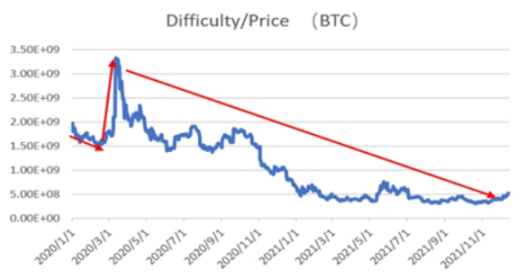
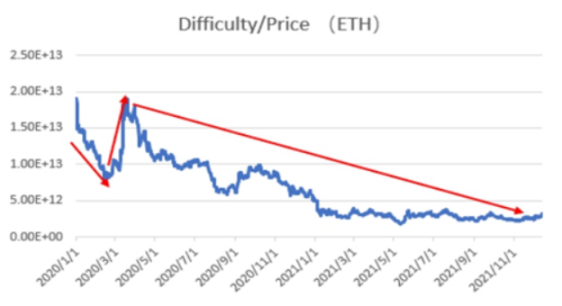
If you join the mining market now, you may encounter the two problems of prolonged payback period and insufficient computing power of a single miner to obtain block rewards. The extension of the payback period is caused by the premium of miners brought by the rise in currency prices and the increase in the cost of new miners. Bitmain’s Antminer S19 Pro, which was reportedly sold at an official price of \(1,897 in November last year, was still completely sold out after doubling the price; at present, the same machine is priced at \)3,769, a 98% markup (Le & Huang, 2021) , The price of the same machine in the second-hand market once reached $7,999, an increase of 321%. Under the situation of rapid and linear cost growth, the return period for investors will be extended accordingly. In addition, Bitcoin and Ethereum, as mainstream cryptocurrencies, have an exponential increase in the computing power base of the entire network in the mining market, and the computing speed of a single mining machine or a small number of devices on this basis is not as good as large mining machine owners, which makes it less likely for such miners to receive block rewards. New cryptocurrencies will also encounter the same problem. As the popularity of the coin increases, more miners will be attracted to the mining market, the computing power of the entire network will increase, and the mining difficulty will also increase accordingly, thus making the probability of miners getting block rewards decrease. In response to these two problems, solutions have also appeared in the market in a timely manner, and were provided to different types of investors. If the investor is a professional who has studied computer equipment, he or she can join the mining pool after purchasing the mining machine to increase the probability of obtaining block rewards. The mining pool is a website established by combining computing power, and the combined computing power of the mining pool can calculate the correct answer faster and obtain block rewards. Under this mechanism, regardless of the computing power possessed by individual miners, as long as they participate in mining activities by accessing the mining pool, they can obtain a small amount of token rewards by contributing to the mining pool. This is the cooperative mode of multi-person cooperative mining, and the rewards are shared according to the level of individual contribution. In this way, individual miners can improve the stability of their miner earnings. In addition to the mining market of mainstream cryptocurrencies, participating in the mining of hot projects can also reap big rewards in the short and medium term. According to the formula: daily mining unit computing power income = daily mining reward/total computing power, in the ideal mode, if the total computing power of the entire network is at the minimum value and the total revenue is at the maximum value, the daily unit computing power profit will be maximized. The first batch mining is in line with this characteristic. The “first batch mining period” refers to the period when the mainnet of the token is completed or shortly after the completion. Because it takes a great deal of time and senior technical support to prepare the mining machine and test in the early stage, the computing power of the entire network during the first mining period will be at a relatively low stage. At the time, the popularity of the token was not too high in the initial stage of the mainnet launch, and the number of miners involved in mining was not large. On the other hand, in order to attract more miners to join in order to maintain the security of the network, the number of block output rewards in the initial 1-3 years of the launch is at the highest level in the overall plan (the specific halving time depends on the specific cryptocurrency). For example, the block output reward of Bitcoin for the first four years is 50BTC/block, and the reward will be halved every four years. Chia, which will be launched on the mainnet in 2021, is the most intuitive example. The unit computing power income of 0.07745XCH/TiB in the initial stage of the mainnet launch is more than 300 times the unit computing power income in November. Miners who have researched computer equipment and networks can look for potential projects in the early stage, and obtain returns in the short to medium term through the mining income of the first mining period. If investors do not know much about computer equipment, the computing power platform lowers the threshold for such investors to enter the mining investment market. The computing power platform sells mining as a service, and investors can participate in mining by renting cloud computing power instead of directly buying or renting mining machines. Such services are also known as cloud mining services. In this mode, investors do not need to purchase expensive mining machines, select mining farms, calculate electricity costs and other costs, and also don’t need to operate and maintain a full-time service.24 hours a day. After the contract ends, if investors do not want to continue purchasing cloud computing services, they do not need to worry about dealing with machines and venues. In addition, the computing power platform provides standard computing power, which means that there is no need to worry about the lack of machine performance and the need for replacement. Although cloud computing services provide non-professionals with convenient investment channels, it does not mean that all cloud computing platforms are reliable. Because the computing power platform sells virtual products, some platforms may use the profit rate as a gimmick to attract users to buy, and then trigger a runaway event. Therefore, when non-professionals purchase cloud computing power, they need to focus on the reliability of the computing power platform. For example, whether the computing power platform is supported by a physical mine, whether the income is received daily, or whether the platform supports real-time withdrawal. The cloud computing power leased by investors on the computing power platform always comes from mining machines, which makes the support of physical mining farms particularly important, because the scale and configuration of the mining farms provides a guarantee for the supply of cloud computing power. In addition, if the computing power platform provides two functions of daily income settlement and real-time withdrawal, it will increase users’ trust in the platform. Users can withdraw profits in a timely manner and carry out capital turnover, which also eliminates users’ worries that the profits may not be able to be withdrawn if they are stored in the platform account for a long time.
Sirius Labs will keep exploring potential projects in 2022
Finding hot projects with great potential is the premise of participating in crypto mining as soon as possible when the mainnet is launched. In addition to the solid technology, financial support from the leading investment institutions is also a must for a potential project. In the following paragraphs, we are going to introduce three projects invested by three top investment institutions. All of these are currently in the testnet/pre-testnet stage.
1. Spacemesh
Spacemesh is committed to building a blockchain mesh operating system, designed to run on everyday users’ home PCs, rather than dedicated cloud servers or specialized non-commodity hardware such as mining farms, thus reducing mining thresholds (Spacemesh Testnet Guide, nd). Just like Chia, Spacemesh uses time and space consensus mechanism (PoST) to replace Proof of Work (PoW), in order to avoid a lot of energy waste and mining centralization. Spacemesh received $15 million in A round, led by the leading investment institution - Polychain(Spacemesh, 2018). 2. Aleo
Aleo’s goal is to develop a platform that utilizes zero-knowledge proofs (ZKPs), which are cryptographic techniques that allow two parties on the Internet, such as applications and users, without sharing the underlying information, to verify the information with each other. In today’s transparent blockchain world, privacy enables the protection of users’ personal data and expands the design space of applications. Howard Wu, the founder of Aleo, has worked closely with some prominent academics at Berkeley, Cornell, Hopkins, and other institutions, and published papers on Zero-Knowledge Proof Research. The Aleo team is capable of strong execution and develops the testnet of their protocol quickly, and wrote the programming language Leoy and a development environment for Aleo. Aleo raised a total of $28 million led by Andreessen Horowitz (a16z), Placeholder VC, Galaxy Digital, Variant Fund and Coinbase Ventures (Roberts, 2021). Aleo is still in the stage of preparing for the testnet. 3. Ironfish
Ironfish is another privacy-focused blockchain project that uses zero-knowledge proofs to create user-friendly private cryptocurrencies. Iron Fish is inspired by the Sapling protocol, which allows users to send transactions in a way that is completely shielded by design. The Iron Fish network is easy to use and has a simple protocol architecture, providing users with a cash-like transaction infrastructure. The core purpose of the project is to lower the bar and make it easy for anyone with a computer to run a node. Iron Fish is led by Elena Nadolinski, a former engineer at Microsoft, Tilt, and AirBnb, who the a16z team described in an article as “a talented individual with technical expertise, passion, and leadership to succeed in this field” (Yahya et.al, 2021). Iron Fish has secured $27.6 million in Series A funding led by A16z (Castillo, 2021).
Reference:
Coinario. (May 20, 2021). How is Crypto Price Determined? Retrieved from https://www.coinario.com/info/how-is-crypto-price-determined Coinbase. (2021). Form S-1 Registration Statement Under The Securities Act of 1933 Coinbase Global, Inc. Retrieved from https://www.sec.gov/Archives/edgar/data/1679788/000162828021003168 Coinbase. (2021). Shareholder Letter Third Quarter. Retrieved from https://s27.q4cdn.com/397450999/files/doc_financials/2021/q3/Coinbase Crunchbase.(n.d.) Retrieved from https://www.crunchbase.com/organization/spacemesh/company_financials Grayscale Research. (2021). Bitcoin Investor Study Third Annual. Retrieved from https://grayscale.com/wpcontent/uploads/2021/12/Grayscale-2021-Bitcoin Hands, J. (2021). Mining vs. Farming, the Data Behind Being Green. Retrieved from https://www.chia.net/2021/10/20/mining-vs-farming.en.html Huang, J et al. (Sept. 3, 2021). Bitcoin Uses More Electricity Than Many Countries. How Is That Possible? The New York Times. Retrieved from https://www.nytimes.com/interactive/2021/09/03/climate/.html Le, K. & Huang, Y. (2021). Bitcoin miners seek 2nd hand gear to drive output amid rally.Retrieved from https://forkast.news/bitcoin-miners-used-crypto-mining-machines/ Messari. (n.d.). Bitcoin, a peer-to-peer electronic cash system. Retrieved from https://messari.io/asset/bitcoin Roberts, J. J. (2021, April 20). Aleo raises \(28M for Blockchain Privacy Tech from Andreessen, Coinbase, others. Decrypt. Retrieved from <https://decrypt.co/68491/aleo/28m-blockchain-privacy> ReporterLinker. (2021). Cryptocurrency Global Market Report 2021: COVID-19 Implications and Growth. Retrieved from \[<https://www.reportlinker.com/p06188071/Cryptocurrency-Global-Market-Report> COVID-19-Implications-And-Growth.html?utm_source=GNW\] \[\](Ssaurel. (2021, October 26). Always Greener – Bitcoin Industry Now Uses the Most Renewable Energy in the World at 57.7%.) Retrieved from <https://www.publish0x.com/in-bitcoin-we-trust/always-greener-bitcoin> Spacemesh. (2018, September 5). Blockmesh or Pioneer Spacemesh raises \)15M in series A funding led by Polychain. Retrieved from https://spacemesh.io/blog/blockmesh-os Spacemesh Testnet Guide. (n.d.). Retrieved from https://testnet.spacemesh.io/#/README University of Cambridge Judge Business School Cambridge Center for Alternative Finance. (2010). Cambridge Bitcoin Electricity Consumption Index. Retrieved from https://ccaf.io/cbeci/mining_map/methodology Yahya, A., Burger, E. & Wuollet, G. (2021). Investing in Iron Fish. Retrieved from https://a16z.com/2021/11/30/investing-in-iron-fish/ Ycharts. (2021). Bitcoin Miners Revenue Per Day. Retrieved from https://ycharts.com/indicators/bitcoin_miners_revenue_per_day*







































































【免责声明】市场有风险,投资需谨慎。本文不构成投资建议,用户应考虑本文中的任何意见、观点或结论是否符合其特定状况。据此投资,责任自负。