


Real Data Sovereignty Time
We see Web3 as an inevitable trend rooted in the Internet development soil. In the latest publications of Tim O’Reilly, who defined Web2, he concludes that data, infrastructure, and differentiated business models as reasons how Web2 cartels built unique, substantial, and lasting assets. (Tim O’Reilly, 2021) This system caused the internet domain of big companies which are in charge of personal data all over the world.
In Web2, users can build their digital profiles on diverse platforms, such as Facebook, Instagram, WeChat, Weibo, Linkedin, etc. Despite the inspiration of their works, enterprises that owned these platforms could immigrate or change their works as long as they wanted. The privacy and security of user property are not guaranteed. The underlying value is not in the hands of users, but the enterprises. Sustainable margins can be maintained by constantly exploiting user data accumulation. In brief, Web2 is about controlling data.
Herein, encryption, in Web3, vital to the revolution, has been facilitating a paradigm shift where users’ power and data ownership are completely returned to users themselves, beyond data monopolies. Business models in Web2, yet, become invalid in Web3 because users no longer rely on platforms. Web3 is about returning democracy to the Web. Every piece of content is endorsed as ownable to creators.
Decentralized world
‘Be conservative in what you do, be liberal in what you accept.’ (Robustness Principle, 2020) As claimed by Gavin Wood, the co-founder of Ethereum, the ethos of Web3 is the foundation of a global decentralized network. In Web3, user persona, transaction behaviors, interaction, assets held, social relations, and other data have transformed from existing public profiles to public infrastructure. Massive tokens can be stored on the blockchain and every single footprint on-chains can be transparent and traceable.
It enables data available to anyone at any time and is hard to change or cheat in the network. Cryptographic mechanisms ensure that users have absolute control over the addition, deletion, and manipulation of their data. Only you and yourself can be the master of your database.
New business opportunities
Encryption effectively unbinds data from applications. It is the time to dig out the data underneath the earth. Roughly 2.5 quintillion bytes of data were created per day in 2021, while it is predicted that 70% of the globe’s GDP will have undergone digitalization. (Jacquelyn Bulao, 2022) Yet, millions of data are still underdeveloped due to the information block by big companies. Thanks to the integration of blockchain technology, a distributed ledger, it offers an immutable and transparent way to store data. Within the emerging technology, relationships between people would be rolled into structural turbulence. Robust interfaces mark the interconnection of people more than ever with blinding speed. The cost of data aggregation has been reduced dramatically and cross-platform data has been sufficiently reused.
In theory, Web3 creates new economics. An alternative world of finance, commerce, communications, and entertainment has already come. The original Web2 business model based on monopolies on user data along with network distribution rights, such as big data promotion, algorithm filters, and information flow is no longer effective in Web3
Web3 enables data to collaborate on unprecedented larger scales accompanied by deeper insights. There follows tremendous opportunities for data producers, distributors, and collaborators to regain a new business model in the relationship throughout the corporation process. Anyone can participate. The era of self-sovereign identity has appeared. Underlying value aspiration should be achieved and enabled.
How to maximize value in Web3?
Native building blocks are created in Web3 to manage identity, property ownership, and financial tracks, relationship networks that are not dominated by any one corporation or entity. Meanwhile, Web3 is on its approach to maturity. An important conclusion of economist Carlota Perez’s analysis is that a true technology revolution must be accompanied by the development of substantial new infrastructure. (Carlota Perez, 2010) Resemble canals and road networks in the industrial revolution; clip fabs and ubiquitous telecommunications in nowadays information stage, the proliferation of infrastructure in Web3 should be developed and consolidated constantly.
It is obvious that, generally, turning the data originally occupied by enterprises into a wider open public infrastructure can maximize the value implementation. However, the lack of a bridge between users and their underlying value makes that difficult. In the progress of switching from Growing Owned Database (GOD) in Web2 to Empowering Synergistic Effect (ESE) in Web3, the most imperative problem to be solved is how can users be directed to profitable circumstances? Generating value among users has become the key to the overall value increment of the network. A sustainable climate needs to be established. Here comes KNN3 Network.
From the monopolistic top-down structure to the collaborative development of build blocks. KNN3 Network helps internalize the value from externalities into the pragmatic business cycle.
Optimize the potential
In the open-data world of Web3, anyone can easily access almost all on-chain data. Almost all visible data is on the same continent, and everyone can work on the same tree in their way — the tree is there. However, these data are isolated, mixed, and enormous, which is difficult for users to use directly. Cleaning and classifying the data is a very cumbersome and resource-consuming behavior. So, how to quickly and efficiently gain the data you need, or even mine the data you thought was useless? That’s where KNN3 Network comes in.
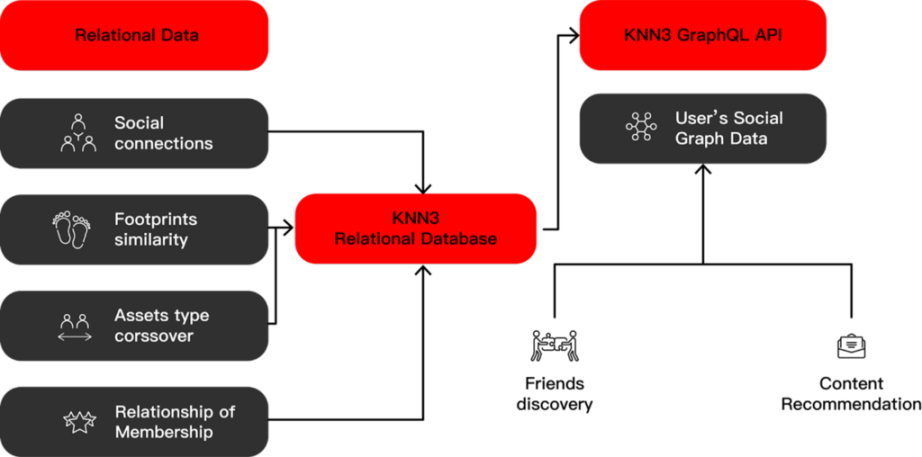
KNN3 Network is a Web3 Relationship aggregator on multi-blockchains. Empowering Web3 social discovery & user enabling. KNN3 Network provides graph solutions for Web3 multiverse relational aggregation to empower Social d/App and AI analytics. KNN3 aims to become a community-driven data curation protocol to enable on-chain data collaboration.
Sparking your Web3 multiverse
A hypothetical group of multiple layers on-chains composes the Web3 multiverse. Web3 is based on multi crypto layers where data or potential relationships are dispersed. Thus, as a multi-layers aggregator, we aim to dig out and collect them to maximum Web3 social discovery and user enablement. Data cross platforms can be blended together seamlessly.
Our Northstar is to empower NFT/DAO/GameFi promoters to discover more Web3 users & have a better user engagement experience with KNN3 profiling/enabling toolkits and allow Web3 d/App builders to provide a better Web3 social experience with KNN3 Network’s multi-chain topological graph solutions.
1)User relational data from blockchain
- NFTs
- POAPs
- Social Relations
- Memberships
2) Empowering Web3 social algorithm d/App in user recommendation & social feeding
- Friends recommendation algorithm
- User profiling for drop & campaigns
3) Relational analytical components for seamless BI query
- Exploring community overlaps between two DAOs
- Tagging cohort with common interests of events and asset ownerships.
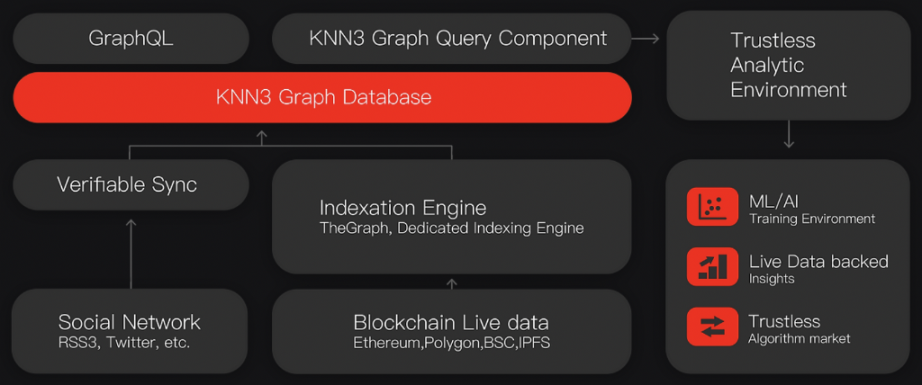
As a Web3 d/App builder, you can seamlessly retrieve abundant Web3 users’ relationships with KNN3 high-performance GraphQL. KNN3 Network collects a variety of relations through users’ historical behaviors and status, which is fully backed by live blockchains. As a Web3 analyst, you can fulfill structural query & relational queries in one place. KNN3 provides SQL-style graph query components for any SQL-compatible BI/analytics platform to integrate the current query service. Moreover, algo Developers can build & train the AI/ML algorithm with graph computation environment solutions.
The future is here and now! We believe in relationship creating meanings, by converting footprints into relational connectors in the form of a massive graph network. We are honored to be a part of the Web3 wave and hope KNN3 Network is able to start the ball rolling.
Reference:
Carlota Perez. (Jan, 2010) Technological revolutions and techno-economic paradigms. Cambridge Journal of Economics. Explore JSTOR. Retrieved from: https://www.jstor.org/stable/24232030
Jacquelyn Bulao. (Jun 03, 2022) How Much Data Is Created Every Day in 2022?. Tech Jury. Retrieved from: https://techjury.net/blog/how-much-data-is-created-every-day/#gref
Robustness Principle. (Sep 01, 2020) Wikipedia. Retrieved from: https://en.wikipedia.org/wiki/Robustness_principle
Tim O’Reilly (Dec 13, 2021) Why it’s too early to get excited about Web3. Oreilly.com. Retrieved from: https://www.oreilly.com/radar/why-its-too-early-to-get-excited-about-Web3/
框架:
1/ Web3 的开放数据范式和数据所有权的改变,用户的基础信息和公开行为带来了对原有(Web2)产品形态和商业模式的冲击。
- 用户的基础画像数据、公开交易、持有、社交关系等行为数据从原有的企业垄断变成了公共基础设施。
- 用户拥有了对数据进行增、删、改的绝对控制权。 (☑️)
2/ 在这些基本变化的推进下,原来基于对用户数据垄断,进而对网络分发权、信息流的 promote/depromote 垄断为壁垒的 Web2 商业模式不再有效。(☑️)
3–1/ Web3 让数据能在在更大范围、更深的维度进行协作,数据的生产者、分发者、加工者、消费者在整个协作关系中将有机会被重新分配激励方式,这使得催生新的商业模式成为可能。(☑️)
3–2/ 然而,新的商业模式设计中依然面临一些问题需要回答:
- On growth model ( 从 Growing owned database 到 Empowering Synergistic Effect 的切换 )
- 如何让用户 / 其他应用产品通过协同效应产生价值就成为网络整体价值增量的关键
- 从顶层设计的垄断式发展 -> Build blocks 的协作式发展 (☑️)
- On value capturing ( 如何内化价值外部性 )
- 显然将原来被企业垄断的数据变成更加广泛的开放公共设施从整体上来看会让数据产生更大的价值影响;
- 然而,大部分的数据创造者并没有办法从中直接获益,所以如何让数据创造者产生更多、更有效的数据;数据分发、加工者提供更好服务,并且更加持续,需要解决。简言之,如何将外部性价值内化到商业循环中。(☑️)































【免责声明】市场有风险,投资需谨慎。本文不构成投资建议,用户应考虑本文中的任何意见、观点或结论是否符合其特定状况。据此投资,责任自负。